
 PÁTEK 2. 10., 15.30 h | O kavárnách i osobnostech, které v nich tvořily a diskutovaly, s kurátory výstavy, historiky Evou Ševčíkovou a Jiřím Sochorkem. Výstava Ostravská kavárna představuje historii kaváren od přelomu 19. a 20. století až po současnost. Přibližuje je jako místa setkávání, architektonické fenomény i centra kulturního a společenského života. Návštěvníci a návštěvnice se dozvědí více o podobě legendárních podniků, jejich proměnách i osobnostech, které byly s kavárenským prostředím spojené. Kapacita prohlídky je 25 osob. Rezervace zdarma od 13. 9. 2026 na GoOut.
 SOBOTA 3. 10., 10 h a 13 h | Fotoarchivem historických snímků Ostravského muzea s historikem Jiřím Sochorkem. Sbírka čítá tisíce snímků, na kterých lze sledovat proměny města, jeho ulic, známých staveb i podob bydlení v různých dobách. Autentické fotografie přibližují, jak se Ostrava postupně utvářela a měnila – od jednotlivých budov až po atmosféru jejích čtvrtí. Prohlídky se konají v 10:00 a ve 13:00. Kapacita každé prohlídky 6 osob. Rezervace zdarma od 13. 9. 2026 na GoOut.
 ÚTERÝ 6. 10., 17 h | O proměnách lokální architektury a způsobu bydlení od 13. do 16. století s archeologem Zbyňkem Moravcem. Jak vypadaly domy, ve kterých žili obyvatelé středověké Ostravy? Co o jejich podobě, uspořádání a každodenním provozu prozradily archeologické výzkumy posledních desetiletí? Kapacita přednášky je 30 osob. Rezervace zdarma od 13. 9. 2026 na GoOut.
 ÚTERÝ 6. 10., 16 h | Výběr ikonických předmětů 50. – 90. let ze sbírek Ostravského muzea s kurátorkou uměleckohistorických sbírek Monikou Piegerovou. Co dělalo domov domovem v druhé polovině 20. století? Výklad přiblíží materiály, technologie a tvary, které formovaly estetiku československých domácností, i nadčasový design, vybavení a technické vymoženosti tvořící pomyslné hvězdy tehdejších interiérů. Kapacita programu je 15 osob. Rezervace zdarma od 13. 9. 2026 na GoOut.
The Beginning of Industry in the Ostrava
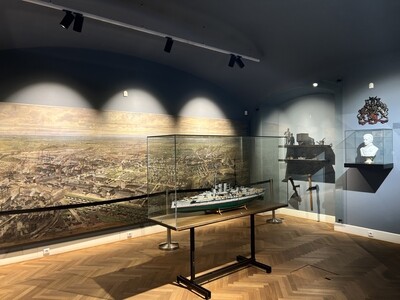
The discovery of coal nearby brought industry and major expansion to Ostrava, hitherto as unknown city. This lithography of the Vítkovice district made by Ernst Wilhelm Knipple between 1874 and 1857 (panel 1, pict. 1), as well as an oil canvas by Otto Bollhagen, show how the city looked as prosperity began to take hold around the turn of the 20th century.
Records indicate that coal was discovered in 1763 in the Burňa Valley in the Silesian part of Ostrava. Regular coal mining started afterwards in 1782.
From an historic point of view, the turning point came when the erstwhile archbishop, archduke Rudolf Jan, decided to allow the production and manufacturing of steel here (panel 2, pict. 1). The date of the letter is December 9th 1828, and regards the establishment of puddling works in the Polish part of Ostrava. Rudolf’s iron works were located in Vítkovice. The arrival of an important investor also influenced the development of industry in Ostrava. Salomon Meyer von Rothschild (panel 2, pict. 4) played that part when he obtained an imperial decree in 1843 enabling him to establish a mining operation in Ostrava (panel 2, pict. 2).
Salomon Meyer von Rothschild lived between 1774 and 1855. In 1843 he purchased Rudolph’s ironworks, officially from the archbishopric in Olomouc, including iron ore and carboniferous mining in Moravian Ostrava and the Vítkovice district. He remained the owner of the iron works in Vítkovice until his death in 1855.
This classic manor house, based on a design by the architect Antonín Kraus in 1847, was seat of the directors of the Mining and Metallurgical industry in Vítkovice and is the only preserved building to the company Vítkovice a.s., dating back to the first half of the 19th century (panel 2, pict. 5).
Stock was issued in 1887 to another Rothschild, giving him a share in the ownership in the so-called Kuks plant of Vítkovice (panel 2, pict. 3).
The machine works, where railway wheels were manufactures, and the steel mill of the mining and metallurgical industry in Vítkovice, which had a forge press with a capacity of 4,500 tonnes, are shown in these two pictures taken in 1910 (panel 2, pict. 7, 8).
Armour plate deliveries for battleships were among a significant source of business at the beginning of 20th century and were proof of the outstanding quality of the products shipped out of Vítkovice. This picture shows the armour plates used for the Austro-Hungarian battleship Erzherzog Karl (panel 2, pict. 6).
The mining and metallurgical industry in Vítkovice delivered armour plates and heavy forgings for the battleship Virbus Unitis and other ships of the Austro-Hungarian fleet. This model of the Viribus Unitis is representative of the latter half of 1914.
These mining tools and miners’ lamps from the 19th century are more proof of the development of the industry in Ostrava.
The Rothschilds owned Vítkovice iron works between 1843 and 1937. Originally called Bauer, this German-Jewish family got the later name of Rothschild based on the red shield located in the middle of their coat of arms, which prides itself on the motto union, honesty and diligence.
Ceremonial flags were a must for all important occasions and celebrations. The flag of the workers of Vítkovice from 1888 depicts St. Florian, the patron of all firemen and protector against disastrous fires. The mining flag of the Ida mine in Hrušov was consecrated at the feast of St. Prokop on July 4, 1885, depicting the patron of the Ostrava mining district, St. Prokop, and St. Barbora, the patroness of the Karvina mining district.
The oldest stream railway in Austria passed through Moravian Ostrava thanks to development of industry. It got its name from Austrian emperor Ferdinand I and reached the borders of Ostrava in 1874. A relief found today in the museum of Ostrava was made in 1839 to mark ceremonial occasion for opening part of the northern line of Ferdinand running from Vienna to Cracow.
Akce: Otevřít verzi pro tisk