
 Výstava nabídne pohled na desítky druhů masožravých rostlin z celého světa – od známých mucholapek přes elegantní láčkovky až po vzácné sběratelské rarity. Seznámíte se s fungováním důmyslných pastí těchto rostlin a vybrané druhy si můžete rovnou zakoupit. Výstava potrvá do 20. 9. 2026 a lze ji navštívit pouze se vstupenkou do muzea.
 ČTVRTEK 17. 9., 17 h | Srdečně zveme na vernisáž výstavy Japonsko v Ostravě. Výstava u příležitosti 10. výročí Česko-japonského kulturního centra představuje dlouhodobý a živý dialog mezi Českou republikou a Japonskem rozvíjený prostřednictvím festivalů, vzdělávání, umění i každodenního života v Ostravě. Nejde pouze o prezentaci exotické kultury, ale o příběh lidí, kteří vytvářejí most mezi vzdálenými světy. Japonsko v Ostravě lze nejen objevovat, ale také prožít a stát se jeho součástí.
 Zveme vás do Ostravského muzea na vernisáž výstavy Vlez mi na záda, která se uskuteční ve čtvrtek 1. října v 17 hodin. Výstavu zahájí Anna Pohořálková, kurátorka výstavy, Filip Petlička, ředitel muzea a Lucie Baránková Vilamová, náměstkyně primátora statutárního města Ostravy. Vystoupí Folklorní soubor Slezan z Českého Těšína. Vstup na vernisáž je volný.

Ostrava’s cafés today
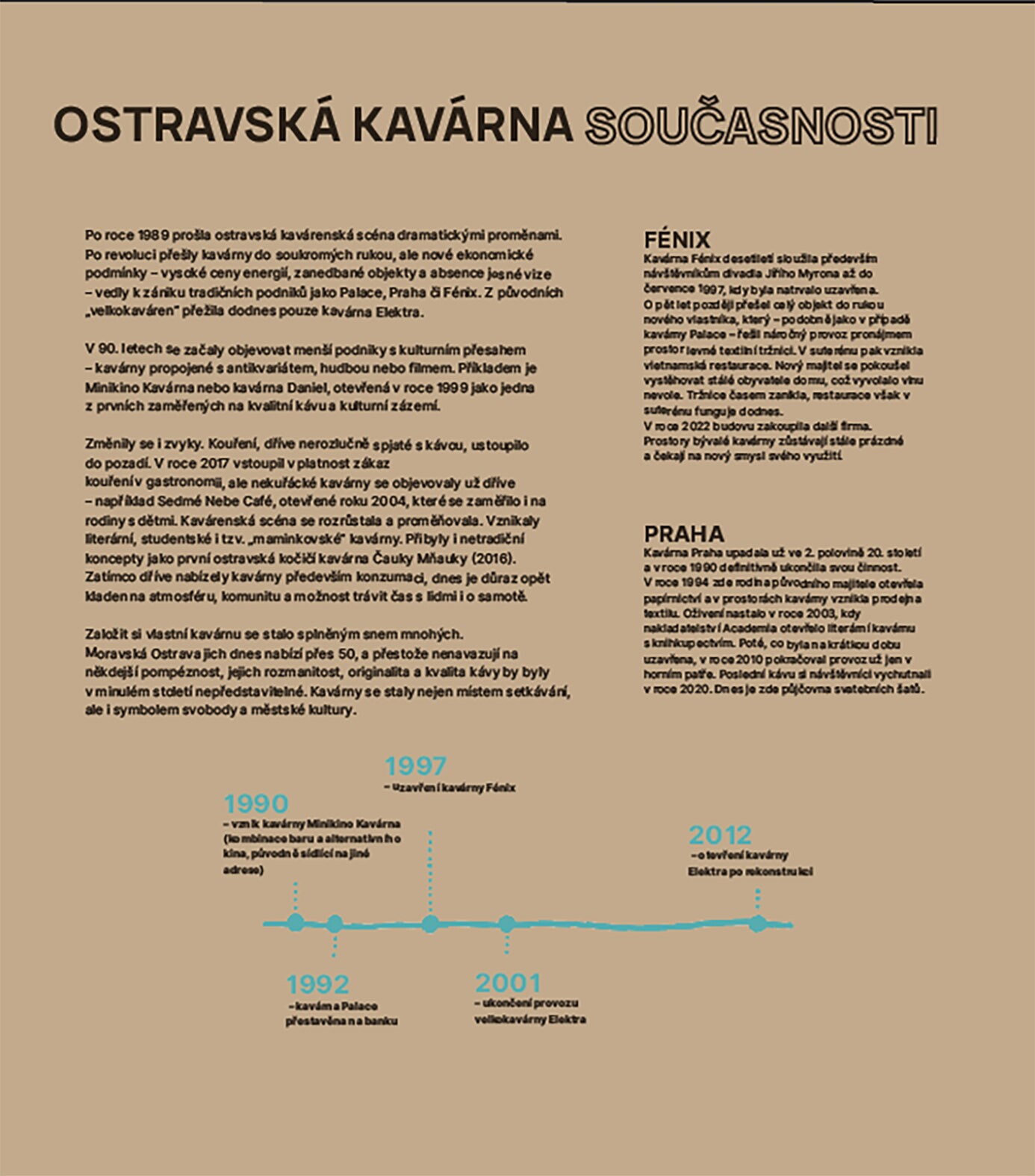
After the collapse of the communist regime in 1989, Ostrava’s café scene underwent dramatic changes. Following the Velvet Revolution, cafés passed into private hands, but the new economic circumstances – high energy costs, dilapidated buildings, and the lack of a clear business vision – led to the demise of traditional establishments such as the Palace, Praha and Fénix cafés. The Elektra is the only one of Ostrava’s former “grand cafés” that still survives today.
In the 1990s, a number of smaller establishments with a cultural focus appeared – cafés combined with second-hand bookstores, music venues or cinemas. Examples include the Minikino café and the Daniel café; opened in 1999, the latter was one of the first of these new cafés to offer high-quality coffee and to double as a cultural venue.
Habits also began to change. Smoking – once inextricably linked with coffee-drinking – became less and less widespread. Smoking in cafés, bars and restaurants was banned in 2017, but by that time a number of non-smoking cafés were already well-established in Ostrava, such as V sedmém nebi (“In Seventh Heaven”), opened in 2004 and catering mainly for families with children.
Ostrava’s café scene continued to grow and evolve. New establishments included literary cafés and cafés targeted at students and mothers with young children. Other cafés followed new trends, such as the cat café Čauky Mňauky (“Ciao Miaow”, opened in 2016). While cafés used to function mainly as places to eat and drink, today the emphasis is once again on atmosphere, community, and the opportunity to spend time either alone or with others.
For many people, starting their own café was a dream come true. Today, Moravská Ostrava (the central part of the Ostrava metropolitan area) has over 50 cafés, and although they lack the pomp and grandeur of their pre-war counterparts, their variety, originality and the quality of their coffee would have been unimaginable in the 20th century. Cafés have become not only places for people to meet, but symbols of freedom and urban culture.
THE FÉNIX CAFÉ
For decades, the Fénix café was mainly used by audiences attending the nearby Jiří Myron Theatre, but in July 1997 it closed its doors for the last time.
Five years later, the entire building passed into the hands of a new owner. As was the case with the Palace café, the premises of the former Fénix café were leased to market traders selling cheap clothes. A Vietnamese restaurant was opened in the basement. There were also attempts to evict the building’s long-term residents, which caused a wave of opposition. The market was eventually closed down, but the basement restaurant is still operating today.
In 2022 the building came into new ownership. The former café premises are still vacant and await new use.
THE PRAHA CAFÉ
Like many cafés, the Praha café went into decline during the second half of the 20th century. A TV report from 1990 mentioned the Praha among the vacant former business premises in Ostrava’s city centre.
In the same year, the building was restituted to its former owner, Zdeněk Mikeska. However, it was in a poor state of repair, and it was also a protected cultural monument; this meant that restoring the building to its former glory would have been very costly, so the café had to be closed down permanently. In 1994 Mr. Mikeska’s sons opened a stationery shop on the ground floor of the building; the shop is still operating today. In the same year they sold the building to a company which opened a shop selling textile goods in the former café premises.
New hopes of a revival came in 2003, when the publishing-house Academia opened a literary café combined with a bookstore, which rapidly gained a loyal clientele. The financial crisis and rising costs forced the café to close in 2010, but local people joined forces with the city council and the University of Ostrava to offer their support, and the café re-opened later the same year, this time only on the upper floor, in the former café premises.
The Academia café closed its doors for the last time in 2020, and today the premises are occupied by a wedding dress rental shop.
Timeline
- 1990 – The Minikino Kavárna is opened (combining a café bar and an arthouse cinema)
- 1992 – The Palace café is converted into bank premises
- 1997 – The Fénix café is closed
- 2001 – The Elektra café is closed
- 2014 – The Elektra café is re-opened following a complete renovation
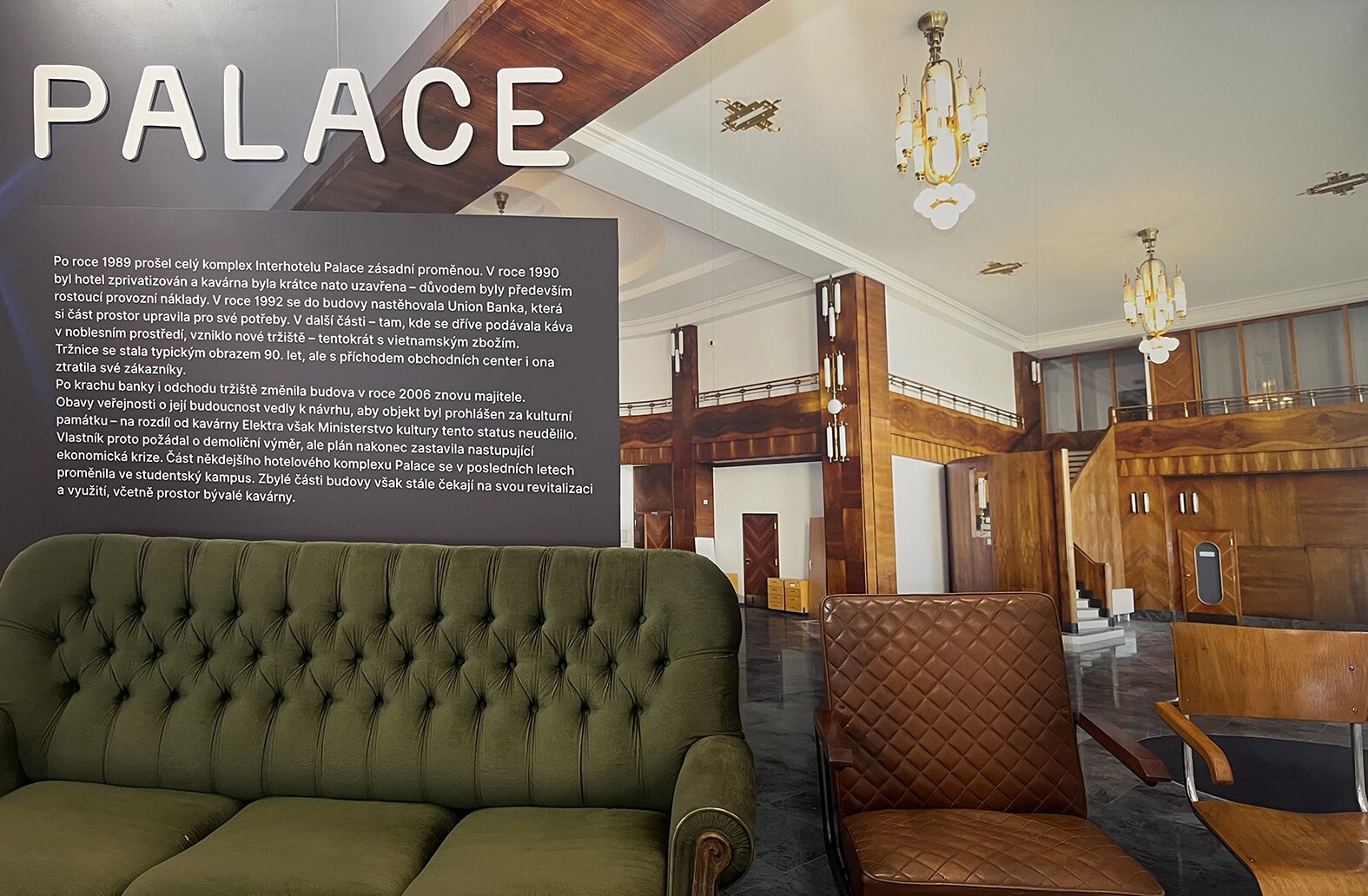
THE PALACE CAFÉ
After 1989, the entire Interhotel Palace complex underwent a major transformation. The hotel was privatized in 1990, and the café was closed shortly afterwards – mainly due to rising operating costs.
In 1992 the Union Bank moved into the building and adapted some of the interiors for its own needs. The main hall of the former café, which had previously been one of Ostrava’s most luxurious and refined establishments, was used as a market by Vietnamese traders selling cheap goods. Like other markets of its type, it was a typical feature of the 1990s in the Czech Republic, but it eventually lost its customers when new shopping centres and retail parks were built.
Eventually the bank collapsed and the market was closed, and in 2006 the building found a new owner. Widespread fears for its future led to a proposal being submitted to list the building as a cultural monument – but unlike the Elektra café, the Ministry of Culture did not accept the proposal. The owner applied for a permit to demolish the building, but the financial crisis intervened to stop these plans from becoming a reality.
In recent years, one part of the former Palace hotel complex has been converted into student accommodation. However, the remainder of the building still awaits revitalization and new use – including the former café premises.
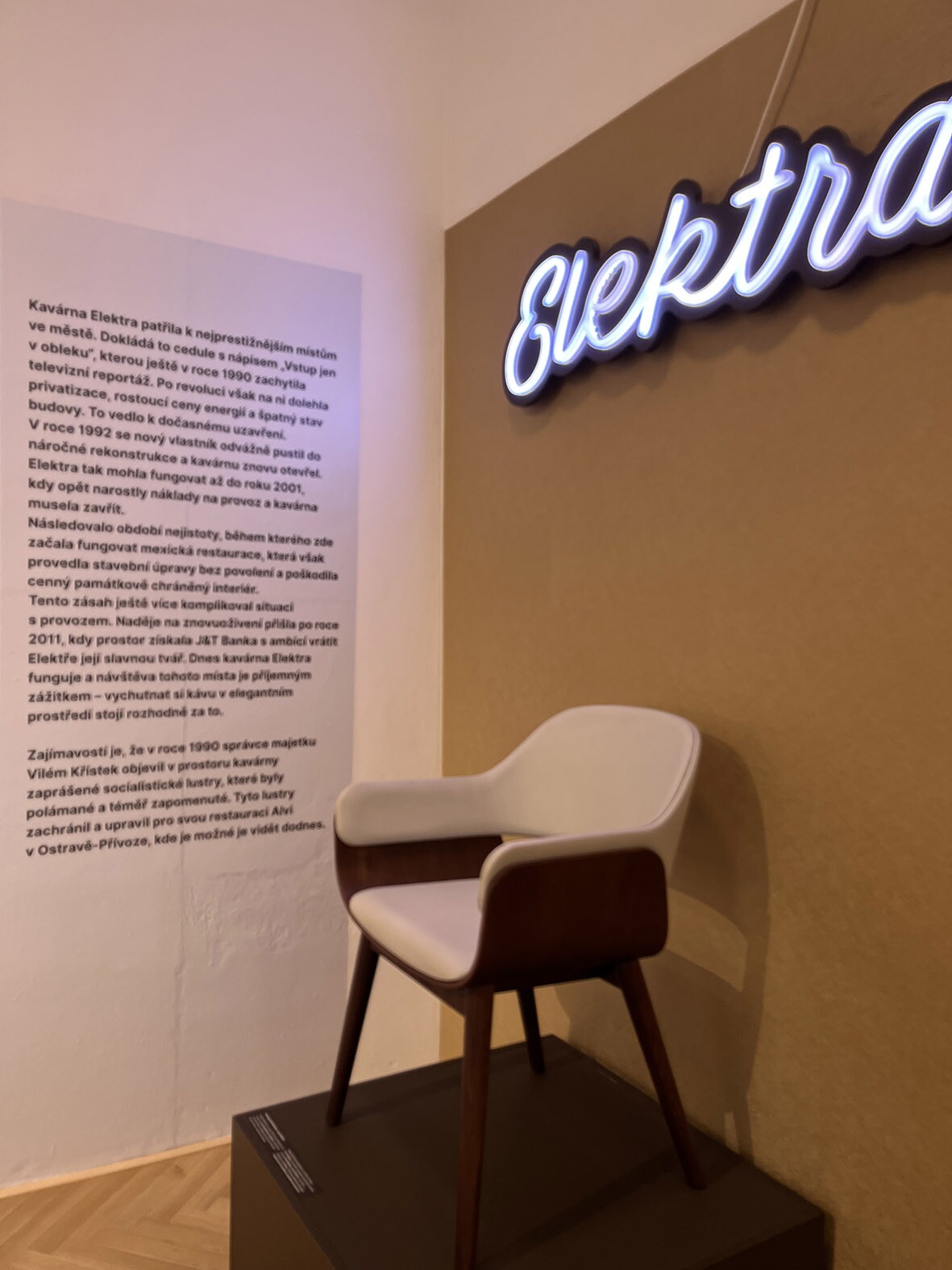
THE ELEKTRA CAFÉ
In its heyday, the Elektra café was one of Ostrava’s most exclusive establishments. This is reflected in a sign stating “Entry only if wearing a suit”, which was captured by a TV report in 1990. After the 1989 revolution the café was privatized, but it soon went into decline due to rising energy prices and the dilapidated condition of the building, and it had to be temporarily closed.
In 1992 the new owner launched an ambitious renovation project and re-opened the café to the public. It operated until 2001, when rising operating costs forced it to close.
A period of uncertainty followed. A Mexican restaurant was opened in the former café premises, but construction work was carried out without a permit, damaging the historically valuable interior of the listed building. This further complicated the situation.
Hopes for a revival came in 2011, when J&T Banka bought the Elektra building with the intention of restoring it to its former glory. The restoration work was carried out in cooperation with Ostrava’s Gallery of Fine Arts, which lent paintings by important regional artists to decorate the interior. The Elektra thus became not just a café, but a cultural space.
Interestingly, in 1990 the property manager Vilém Křístek discovered several dusty chandeliers from the communist era in the café. They were broken and almost forgotten, but he rescued them, restored them and installed them in his Alvi restaurant in Ostrava’s Přívoz district, where they can still be seen today.
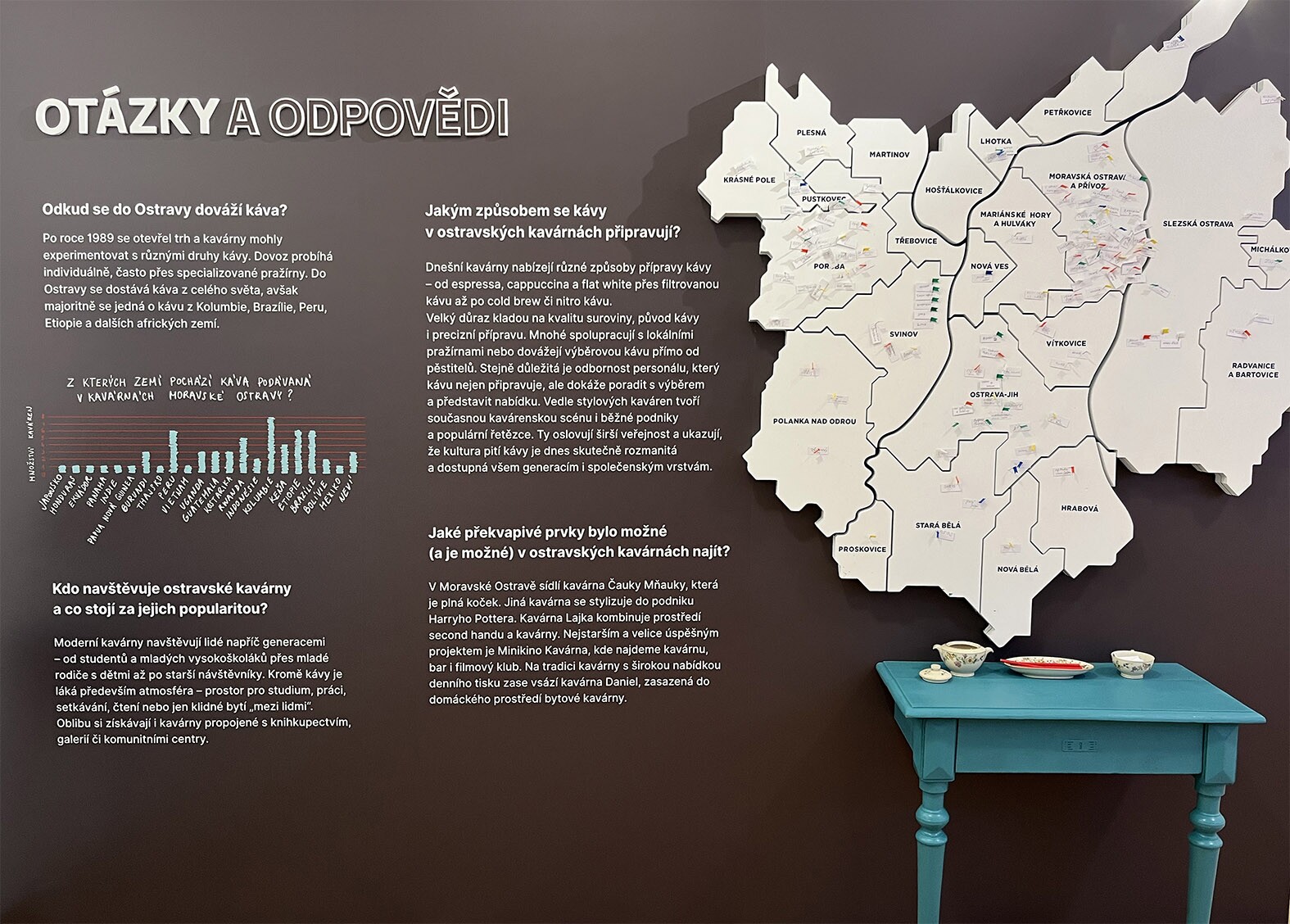
QUESTIONS AND ANSWERS
Where is coffee imported from today?
After 1989, the market opened up and cafés in Ostrava could experiment with various types of coffee. Coffee is imported by individual customers, often via specialist roasters. It is sourced from all over the world, but the primary producers are Colombia, Brazil, Peru, Ethiopia and other African countries.
Who frequents Ostrava’s cafés today, and what are the main reasons for their popularity?
Modern cafés attract people from all generations, from school and university students to young families and older people. Besides the coffee, they also come for the atmosphere; cafés are ideal places to study or work, to meet and socialize, or simply to be among other people. Cafés combined with bookstores, galleries or community centres have also become popular.
What types of coffee are most often served in Ostrava’s cafés?
Today’s cafés offer a plethora of different types of coffee – espresso, cappuccino, flat white, filter coffee, cold brew, nitro coffee and many more. There is a strong emphasis on the quality of the ingredients, the origin of the coffee and the precision of its preparation. Many cafés work with local roasters or import premium-quality coffee direct from the growers. Equally important is the expertise of café staff, who not only prepare the coffee, but can also present the café’s offerings and advise customers on their choice. Besides upmarket boutique cafés, Ostrava also has a wide range of popular mainstream cafés and national or international chains. These appeal to a broad customer base, showing that today’s coffee culture is truly diverse and stretches across all generations and sections of society.
What are some of the more unique or unusual aspects of Ostrava’s café scene?
Moravská Ostrava has a café called Čauky Mňauky (“Ciao Miaow”) which is full of cats. Another café is based on a Harry Potter theme. Lajka combines a café with a second-hand clothing store. Ostrava’s Minikino Kavárna was a pioneer on the city’s post-1989 scene, combining a café bar with an arthouse cinema screening alternative films. The Daniel café draws on the long tradition of cafés offering a range of newspapers for guests to read, and it is situated in a private apartment, giving it a uniquely home-like feel.
Fun facts about coffee
Did you know that…?
- Brazil is the world’s premier coffee-growing country, producing around 3 million tonnes per year.
- Coffee is the second most traded commodity in the world, after oil.
- Czechs drink over 5.8 billion cups of coffee per year.
- A coffee tree usually lives for around 50 years. However, it takes 3–4 years after planting for a tree to start fruiting, and it then produces its fruit (cherries) for 20–25 years.
- Coffee grounds are not waste – they are a treasure for the garden! They contain residues of caffeine as well as valuable minerals such as magnesium, potassium, nitrogen, phosphorus and copper. Coffee grounds are an excellent natural fertilizer, and they also repel slugs, ants and beetles.
- Some of the world’s most expensive coffees exist thanks to animals. Civet coffee gains its mild, earthy and chocolatey flavour because the beans have passed through a civet’s digestive tract after being eaten. Elephant dung coffee from Thailand is a similar (and similarly exclusive) product; the beans have a smooth flavour with notes of chocolate and tropical fruit.
- At the time of writing, Moravská Ostrava currently has 52 cafés with an interior capacity of 920 seats. Interestingly, the city only had 18 cafés in the inter-war period, but they had around 9 500 seats in total, reflecting the fashion for cafés on a very grand scale.
- Customers of Moravská Ostrava’s cafés drink around 1205 kg of coffee per month.
Akce: Otevřít verzi pro tisk