

The coffee tree: a humble plant with a remarkable story
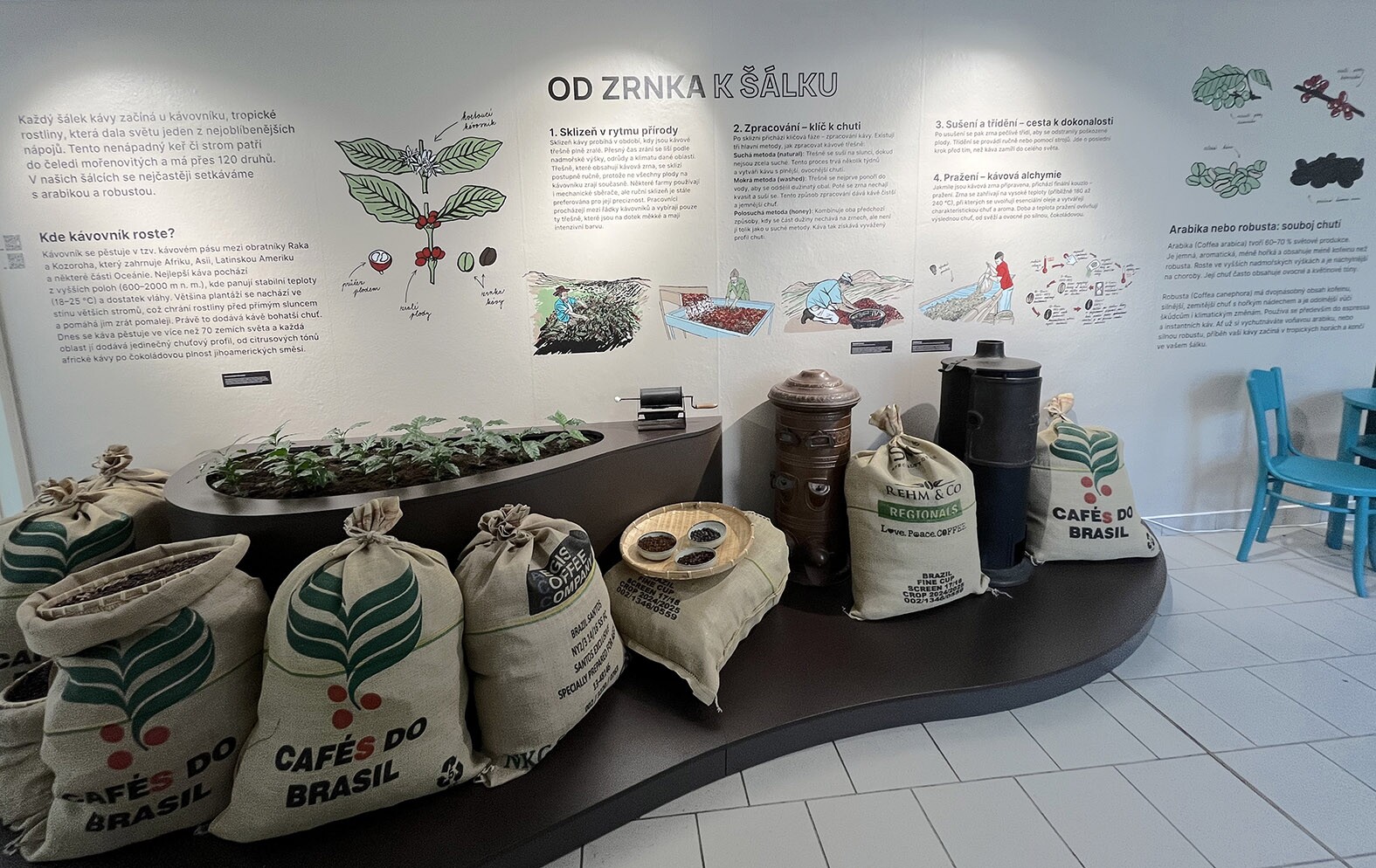
Every cup of coffee begins with the coffee tree – a tropical plant that has given the world one of its most popular drinks. This unremarkable-looking shrub or small tree belongs to the Rubiaceae family, and there are over 120 species – of which arabica and robusta are the most frequently cultivated for our consumption.
Where do coffee trees grow?
Coffee trees are found in the so-called “coffee belt” between the Tropic of Cancer and the Tropic of Capricorn – in Africa, Asia, Latin America and some parts of Oceania. The finest coffee comes from higher elevations (600–2000 metres above sea level), where temperatures are stable (18–25°C) and there is sufficient rainfall. Most coffee plantations are located in the shade of taller trees, protecting the coffee plants from direct sunlight. This slows the ripening process, which gives the coffee a richer flavour. Today, coffee is cultivated in over 70 countries, and the natural conditions in each region give a unique flavour profile to that region’s coffee, ranging from the citrus notes that are typical of African coffees to the rich chocolate tones of South American blends.
Is coffee a fruit?
Coffee trees have white flowers whose scent resembles jasmine. The fruits, commonly known as “coffee cherries”, ripen for 6–9 months, and their colour ranges from red through orange to yellow. Each cherry typically contains two seeds, which are known as coffee beans.
Arabica or robusta: contrasting flavours
Arabica (Coffea arabica) makes up 60–70% of global coffee production. It is milder, more aromatic and less bitter than robusta, and it contains less caffeine. Arabica grows at higher elevations, and it is more vulnerable to diseases. Its flavour often contains fruity and floral notes.
Robusta (Coffea canephora) contains twice as much caffeine as arabica. It has a stronger, earthier flavour with higher bitterness, and it is more resistant to pests and changes in climate. It is mostly used for espresso and instant coffees.
Whether you are enjoying a fragrant arabica or a powerful robusta, your coffee’s story begins in the tropical hills and ends in your cup.
|
Drawings: |
|
|
A coffee tree and coffee beans |
Lexikon kávy, p. 9, 11, 12 |
|
Arabica and robusta beans |
Lexikon kávy, p. 10 |
II. From the beans to your cup
1. Harvesting in the rhythm of nature
Coffee is harvested when the fruits (cherries) are fully ripe. The exact ripening time depends on the elevation above sea level, the variety of the coffee trees, and the local climate. The cherries, which contain the coffee beans, are harvested by hand in stages, because they do not all ripen at the same time. Some farms use mechanized harvesting equipment, but manual harvesting is still preferred for its precision. The harvesters walk between the rows of coffee trees and select only those cherries that are soft to the touch and have an intense colour.
2. Processing – the key to flavour
After harvesting comes the key phase – processing. There are three main methods of processing coffee cherries:
- The dry method (natural): The cherries are sun-dried until all the moisture has evaporated. This process takes several weeks, and the resulting coffee has a full, fruity flavour.
- The wet method (washed): The cherries are first soaked in water to remove the fruity material around the beans. The beans are then fermented and dried. This method gives the coffee a clean, mild flavour.
- The semi-dry method (honey): Honey processing is a combination of the dry and wet methods. Some of the fruity material is left on the beans, but not as much as in the dry method. This gives the coffee a balanced flavour profile.
3. Drying and sorting – the path to perfection
After drying, the beans are carefully sorted to remove any that are damaged. Sorting is done by hand or using machinery. It is the final step before the coffee is transported all over the world.
4. Roasting – coffee alchemy
Once the coffee beans are ready, the final magic can happen – roasting. The beans are heated to high temperatures (from around 180°C up to 240°C), releasing their essential oils and creating the coffee’s characteristic flavour and aroma. The length and temperature of the roast affect the resulting flavour, which ranges from fresh, fruity notes to powerful tones of chocolate.
|
Drawings: |
|
|
The coffee harvest |
Lexikon kávy, p. 15 |
|
Processing coffee beans |
Lexikon kávy, p. 16-18 |
|
The roasting process |
Lexikon kávy, p. 21 |
|
Grinding coffee |
Lexikon kávy, p. 28 |
What are the origins of coffee?
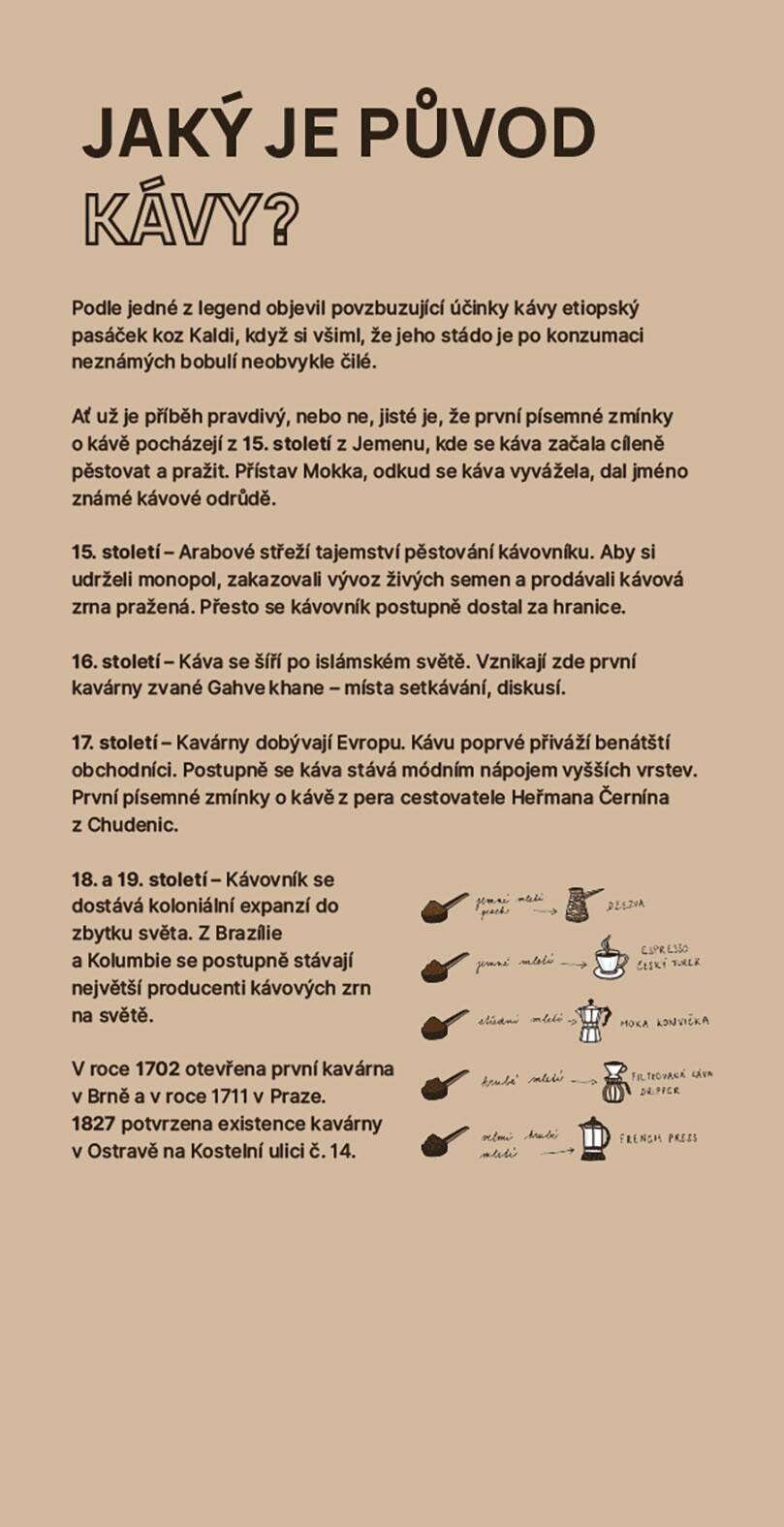
According to one legend, an Ethiopian goatherd named Kaldi discovered the stimulating effects of coffee when he noticed that his goats became unusually lively after eating some unknown berries.
Whether this story is true or not, we know for sure that the first written mention of coffee dates from the 15th century in Yemen, where people began cultivating and roasting coffee. The beans were exported from the port of Mokha, which gave its name to the popular Mocha bean variety.
15th century – The Arabs kept coffee cultivation a closely guarded secret. To retain their monopoly on the commodity, they prohibited the export of live seeds and only sold beans that had already been roasted. Despite these efforts, coffee trees eventually found their way to other countries.
16th century – Coffee spread throughout the Muslim world. The first coffee-houses were established; known in Persian as ghahve-khane, they were places where people met and talked.
17th century – Coffee conquered Europe. First imported by Venetian traders, coffee gradually became a fashionable beverage in high society.
The first written mention of coffee in Czech – in an account given by the traveller Heřman Černín of Chudenice.
18th and 19th centuries – Coffee trees spread throughout the world as a result of European colonial expansion. Brazil and Colombia became the largest global coffee producers.
The first coffee-house in Brno was opened in 1702, and the first in Prague was established in 1711.
The existence of a coffee-house in Ostrava (at no. 14, Kostelní Street) was confirmed in a document from 1827.
NEXT →
Akce: Otevřít verzi pro tisk