
 Výstava nabídne pohled na desítky druhů masožravých rostlin z celého světa – od známých mucholapek přes elegantní láčkovky až po vzácné sběratelské rarity. Seznámíte se s fungováním důmyslných pastí těchto rostlin a vybrané druhy si můžete rovnou zakoupit. Výstava potrvá do 20. 9. 2026 a lze ji navštívit pouze se vstupenkou do muzea.
 ČTVRTEK 17. 9., 17 h | Srdečně zveme na vernisáž výstavy Japonsko v Ostravě. Výstava u příležitosti 10. výročí Česko-japonského kulturního centra představuje dlouhodobý a živý dialog mezi Českou republikou a Japonskem rozvíjený prostřednictvím festivalů, vzdělávání, umění i každodenního života v Ostravě. Nejde pouze o prezentaci exotické kultury, ale o příběh lidí, kteří vytvářejí most mezi vzdálenými světy. Japonsko v Ostravě lze nejen objevovat, ale také prožít a stát se jeho součástí.
 Zveme vás do Ostravského muzea na vernisáž výstavy Vlez mi na záda, která se uskuteční ve čtvrtek 1. října v 17 hodin. Výstavu zahájí Anna Pohořálková, kurátorka výstavy, Filip Petlička, ředitel muzea a Lucie Baránková Vilamová, náměstkyně primátora statutárního města Ostravy. Vystoupí Folklorní soubor Slezan z Českého Těšína. Vstup na vernisáž je volný.

The boom of Ostrava’s grand cafés
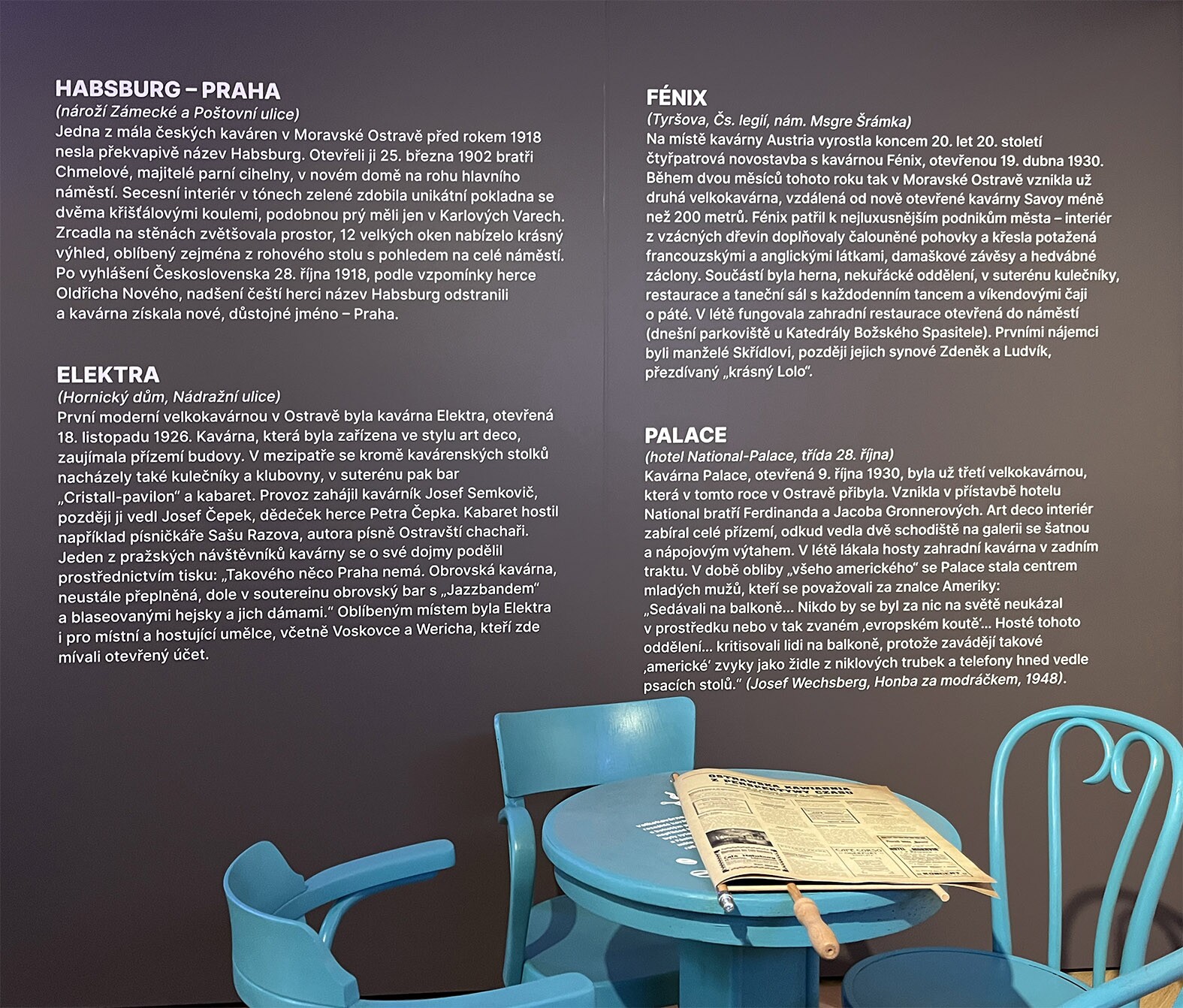
THE HABSBURG / PRAHA CAFÉ
(on the corner of Zámecká Street and Poštovní Street)
One of the few cafés in Ostrava that had a distinctly Czech identity even before the country’s independence in 1918, it was paradoxically named the Habsburg café after the Austrian imperial family. Opened on 25 March 1902 by the Chmel brothers, the owners of a local brick factory, it was situated in a new building in the corner of the city’s main square. Featuring furniture in the Secession style (an Austrian variant of Art Nouveau) and a green-based colour scheme, the interior was dominated by an imposing counter illuminated by two crystal balls – a decorative element that could only otherwise be seen in the Bohemian spa town of Karlovy Vary (Karlsbad). The mirrors on the walls created a spacious impression. Located on the first floor of the building, the café had 12 large windows, and the corner section of the room was particularly popular among guests because it offered impressive views of the entire square. The café changed its name on 28 October 1918, when Czechoslovakia declared its independence. According to the actor Oldřich Nový, who at the time belonged to one of Ostrava’s theatre companies (based at the Czech National Centre), the name change happened mainly thanks to a group of Czech actors, who in their exuberant celebrations of their country’s independence removed the original name from the building. The café was then renamed Praha in honour of Czechoslovakia’s capital.
THE ELEKTRA CAFÉ
(the Miners’ Centre, Nádražní Street)
One of the first modern grand cafés of Czechoslovakia’s post-independence era, the Elektra café, was opened on 18 November 1926. Designed in an Art Deco style, the main hall was located on the ground floor of a palatial building called the Miners’ Centre. There was more seating – plus billiard tables and function rooms – on the upper mezzanine level, and the basement area contained the “Cristall-pavilon” bar and cabaret. The first manager of the Elektra was Josef Semkovič, a well-known figure on Ostrava’s café scene who had previously run the Praha café and who later opened the Savoy café (in 1930). For a time, the Elektra was managed by Josef Čepek, the grandfather of the actor Petr Čepek and the Ostrava-based operetta singer Karel Čepek. The bar and cabaret were run with great opulence, and regular guests included the Prague songwriter Saša Razov, who often compered the cabaret performances and who wrote a popular song in tribute to the city. One visitor from Prague described his impressions in a newspaper article: “Prague has nothing like this. A huge café, constantly full of people, a huge bar in the basement with a jazz band and flashy guys with their ‘ladies’. Coloured lights illuminate the dancers from below through a glass floor.” The Elektra was a favourite haunt of local and visiting artists after performances; the popular acting duo Jiří Voskovec and Jan Werich kept an open tab there.
THE FÉNIX CAFÉ
(Tyršova St., Čs. legií St., Msgre Šrámka Square)
At the end of the 1920s, an imposing new building with five floors was built on the former site of the Austria café, one of Ostrava’s first coffee-houses. The entire ground-floor level was occupied by the Fénix (Phoenix) café, which opened on Saturday 19 April 1930. It was the second grand café to open its doors in Ostrava within just two months; the Savoy café, which opened a month earlier, was located less than 200 metres away. The Fénix had one of the most luxurious interiors in the city. The wall panels and furniture were made of rare woods, the sofas and chairs featured top-quality upholstery with French and English cloth, and the large windows were hung with damask drapes and long silk curtains. Next to the main café hall was a games room and a non-smoking area. The basement contained billiard tables, a small restaurant and a dance hall; there was dancing every evening, and afternoon tea was served at weekends. In the summer, guests could enjoy outdoor seating in the square (now the car park outside the cathedral). The first tenants were the Skřídlos, who had formerly owned two Ostrava hotels (the National and the Slavia). After Ludvík Skřídlo’s death, the café was managed by his sons Zdeněk and Ludvík Jr. (the latter was nicknamed “beautiful Lolo).
THE PALACE CAFÉ
(Hotel National / Palace, 28. října Street)
Opened on 9 October 1930, the Palace was the third grand café opened in Ostrava during that year. It was located in an extension of the National Hotel, which had been built by the hotel’s new owners, the brothers Ferdinand and Jacob Gronner. Fitted out in an Art Deco style, the café occupied the entire ground floor, from where two staircases led up to a gallery with its own cloakroom; drinks were sent up to the gallery in a small elevator known as a dumbwaiter. There was also an outdoor seating area in the rear tract of the hotel. At a time when American styles were the latest fashion, the Palace café became a popular meeting-place for young men who considered themselves connoisseurs of everything American, who used to sit on the balcony: “No member of the balcony crowd would be seen, dead or alive, in the Café’s center or ‘European’ section, where the town’s substantial citizens met to discuss the general decay of good manners in the balcony” and criticized their introduction of such “American” features as nickel-pipe chairs and telephones on desks. The third section of the café was known as “Little Asia”; it was a meeting-place for professional cardplayers, travelling salesmen and various hustlers and shysters who were a product of Ostrava’s geographical location at the crossroads between Western Europe and the Balkans: “They had excellent connections and were able to deliver at a moment’s notice Polish passports, Bulgarian hides, original Persian rugs from Slovakia…” (Joseph Wechsberg, Looking for a Bluebird, Boston 1944).
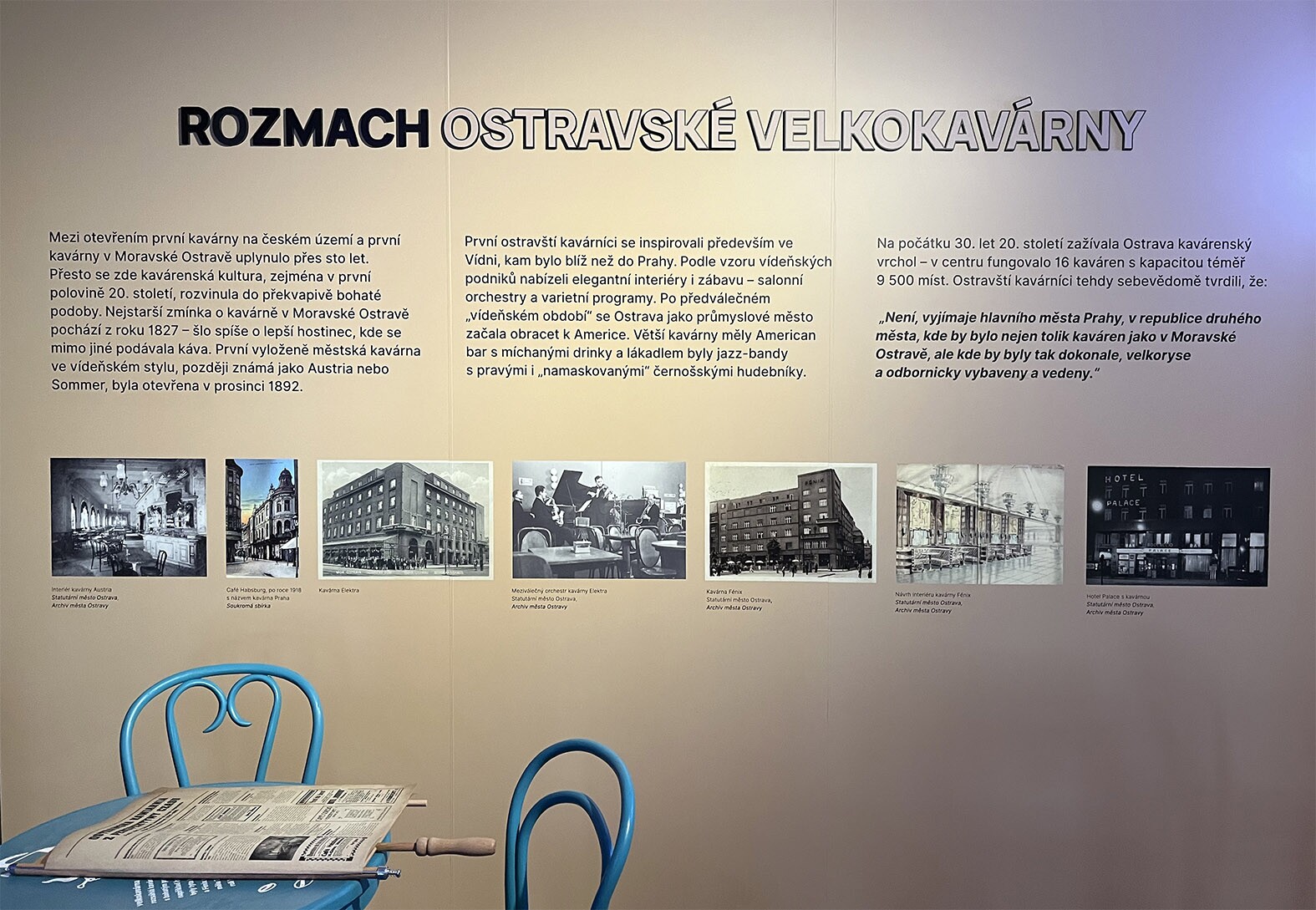
Over a century passed between the opening of the first café in what is now the Czech Republic and the opening of Ostrava’s first café. Despite this delayed start, a surprisingly rich and vibrant café culture developed in the city, especially during the first half of the 20th century.
The oldest documented mention of a café in Ostrava dates from 1827, though in reality it was probably a somewhat upmarket type of tavern which also served coffee. It was followed by numerous similar businesses which came and went during the course of the 19th century – but the first genuine Viennese-style café in Ostrava (later known as the Austria or the Sommer café) was opened in December 1892.
The imperial capital Vienna was a natural model for Ostrava’s cafés. The city was more easily accessible than Prague, and Ostrava’s café-owners took inspiration from Vienna’s grand café interiors as well as their typical atmosphere and the various trappings of Viennese café society, including musical performances. Cafés were packed with guests enjoying concerts by salon orchestras or variety groups. Later, when Ostrava’s industrial boom was at its peak, the city’s cafés began to adopt an American style. There were “American bars” that served cocktails and hosted jazz bands – whose musicians sometimes wore blackface makeup in an attempt to create an “authentic” American jazz atmosphere.
Ostrava’s café scene reached its peak at the beginning of the 1930s. The central part of the city boasted 16 cafés, with seating for almost 9000 guests. The café-owners were able to claim confidently that “with the exception of the capital Prague, there is no other city in the country that has more cafés than Moravská Ostrava, and nowhere else are those cafés so generously equipped and professionally run.”
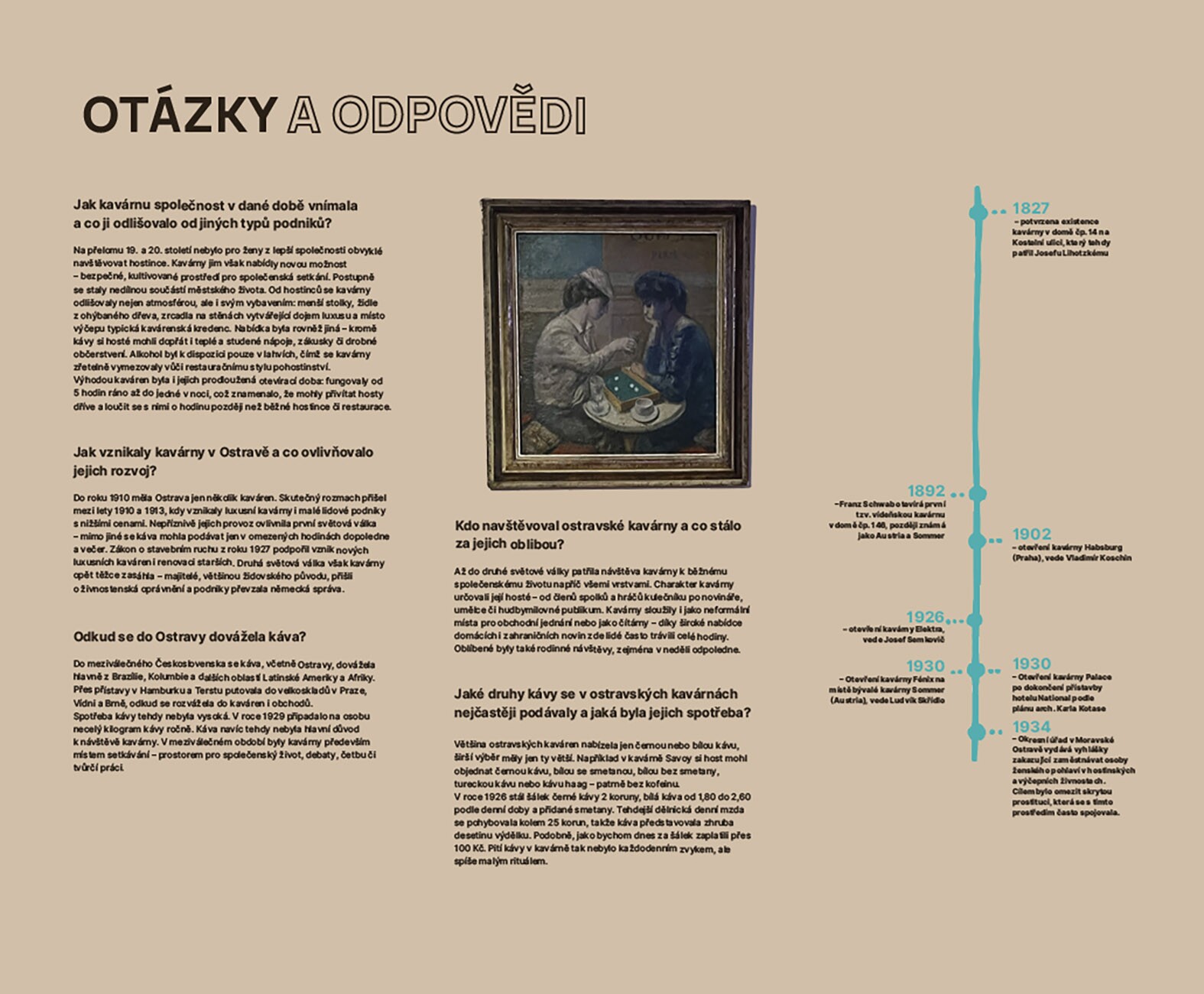
QUESTIONS AND ANSWERS
How were cafés perceived in this era, and how did they differ from other types of establishments?
At the turn of the 20th century, it was not common for respectable women to frequent taverns. However, cafés offered a new option for women – a safe, cultivated environment for socializing. Cafés gradually became an integral part of urban life. They differed from taverns not only in their atmosphere, but also in their furnishings: they had smaller tables, chairs made of bent wood, mirrors on the walls to create an impression of luxury, and a typical café-style counter instead of a bar. They also offered a different range of food and drink – besides coffee, guests could enjoy hot and cold beverages, cakes and light snacks. Alcohol was only sold in bottles; this also clearly differentiated cafés from taverns.
In addition, cafés had the advantage of longer opening hours: they operated from 5 a.m. to 1 a.m., meaning that they could welcome guests earlier and say goodnight later than ordinary taverns or restaurants.
How were cafés established in Ostrava, and what influenced their development?
Up to 1910, Ostrava had only a few cafés. The real boom came between 1910 and 1913, with the opening of opulent grand cafés as well as smaller, more reasonably priced establishments. Their operations were impacted by the First World War, when they were only permitted to serve coffee during restricted hours in the afternoons and evenings. In 1927, a new building law encouraged the establishment of new luxury cafés and the refurbishment of existing cafés. However, the Second World War hit Ostrava’s cafés hard; the mainly Jewish owners had their business licences revoked, and their cafés were taken over by the German authorities.
Where was coffee imported from?
The most important suppliers of coffee to inter-war Czechoslovakia – including Ostrava – were Brazil, Colombia and other countries in Latin America and Africa. The coffee was shipped to the European ports of Hamburg and Trieste, from where it was transported to large warehouses in Prague, Vienna and Brno, which supplied it to cafés and shops.
Coffee consumption was not high in Czechoslovakia during the inter-war period; in 1929 it was less than one kilogram per capita per year. Indeed, coffee was often not considered the main reason for going to a café; between the two world wars, cafés were seen primarily as places for meeting, socializing, debating, reading, or creative work.
Who frequented Ostrava’s cafés, and what were the main reasons for their popularity?
Up until the Second World War, going to a café formed an integral part of everyday social life at all levels of society. A café’s individual character was determined by its guests – members of various clubs and associations, billiard-players, journalists, artists, or music-lovers. Cafés were used as informal venues for business meetings or as reading rooms; they offered a wide range of newspapers (including the foreign press), and people would often spend hours reading in cafés. They were also popular for family visits, especially on Sunday afternoons.
What types of coffee were most often served in Ostrava’s cafés, and how much did people drink?
Most cafés in Ostrava only served black or white coffee; only the largest cafés had a wider selection. For example, in the Savoy café guests could order black coffee, white coffee (with cream), “Turkish” coffee, or Café HAG (decaffeinated).
In 1926, a cup of black coffee cost 2 crowns, and white coffee cost between 1.80 and 2.60 crowns depending on the time of day and the amount of cream added. An average daily wage for a manual labourer was around 25 crowns, so a cup of coffee would be around one-tenth of this sum; it would be like paying 200–300 CZK for a cup of coffee today. This meant that drinking coffee at a café was generally not a daily habit, but rather a small ritual for a special occasion – like we might enjoy a slice of cake at a stylish city-centre café today.
Timeline
- 1827 – A document confirms the existence of a coffee-house in building no. 14 on Kostelní Street, which at the time belonged to Josef Lihotzky
- 1902 – The Habsburg (Praha) café is opened, run by the Chmel brothers
- 1926 – The Elektra café is opened, run by Josef Semkovič
- 1930 – The Fénix café is opened on the site of the former Sommer (Austria) café, run by Ludvík Skřídlo
- 1930 – The Palace café is opened in the new extension of the National Hotel (designed by the architect Karel Kotas)
- 1934 – The District Authority in Moravská Ostrava issues ordinances prohibiting the employment of female staff in taverns and inns; the aim was to prevent clandestine prostitution, which was a common occurrence at such establishments
Akce: Otevřít verzi pro tisk