
 Výstava nabídne pohled na desítky druhů masožravých rostlin z celého světa – od známých mucholapek přes elegantní láčkovky až po vzácné sběratelské rarity. Seznámíte se s fungováním důmyslných pastí těchto rostlin a vybrané druhy si můžete rovnou zakoupit. Výstava potrvá do 20. 9. 2026 a lze ji navštívit pouze se vstupenkou do muzea.
 ČTVRTEK 17. 9., 17 h | Srdečně zveme na vernisáž výstavy Japonsko v Ostravě. Výstava u příležitosti 10. výročí Česko-japonského kulturního centra představuje dlouhodobý a živý dialog mezi Českou republikou a Japonskem rozvíjený prostřednictvím festivalů, vzdělávání, umění i každodenního života v Ostravě. Nejde pouze o prezentaci exotické kultury, ale o příběh lidí, kteří vytvářejí most mezi vzdálenými světy. Japonsko v Ostravě lze nejen objevovat, ale také prožít a stát se jeho součástí.
 Zveme vás do Ostravského muzea na vernisáž výstavy Vlez mi na záda, která se uskuteční ve čtvrtek 1. října v 17 hodin. Výstavu zahájí Anna Pohořálková, kurátorka výstavy, Filip Petlička, ředitel muzea a Lucie Baránková Vilamová, náměstkyně primátora statutárního města Ostravy. Vystoupí Folklorní soubor Slezan z Českého Těšína. Vstup na vernisáž je volný.

Ostrava’s cafés under communism
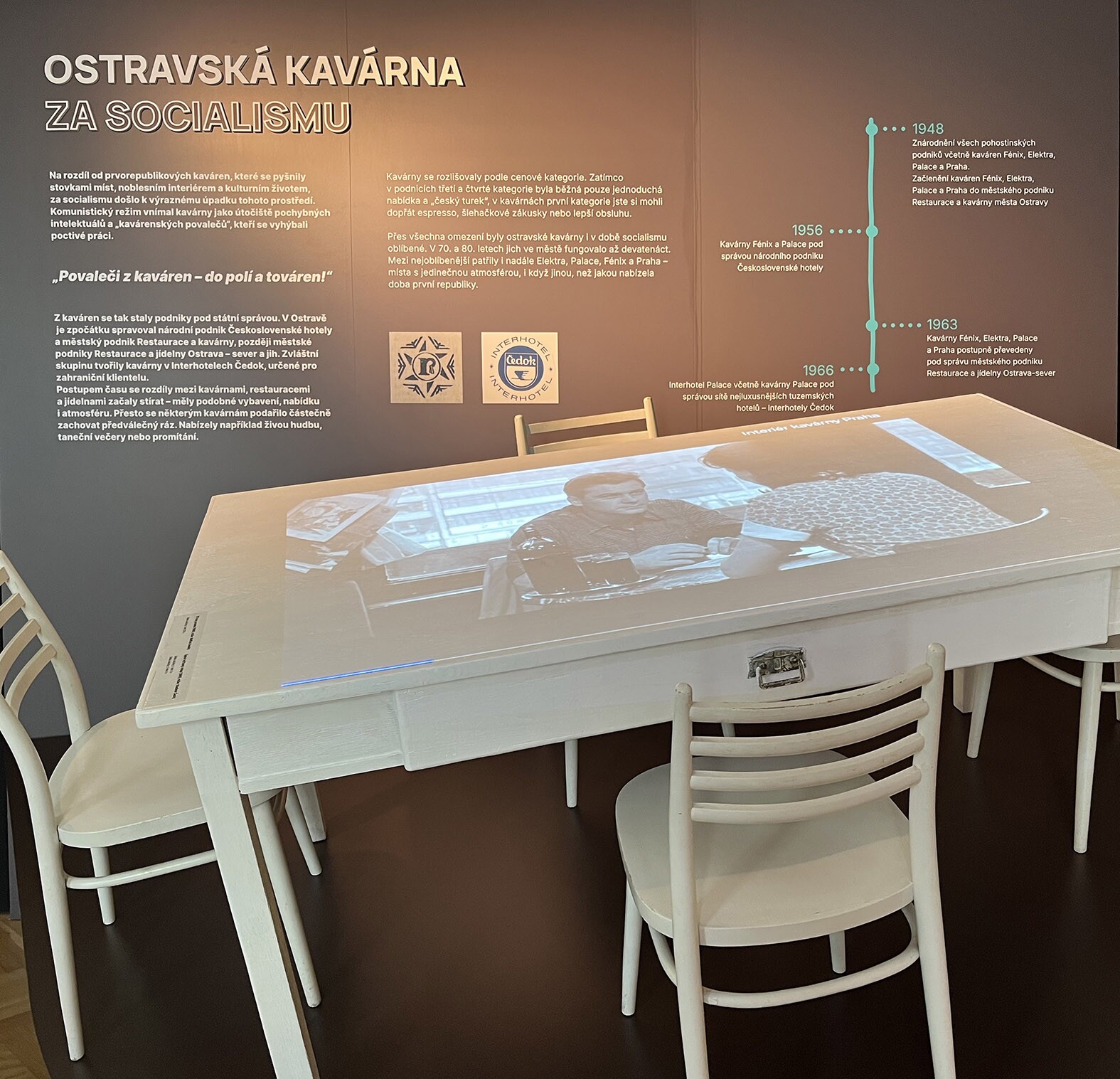
In the 1920s and 30s, Ostrava’s cafés offered hundreds of seats, opulent interiors and a rich cultural life. However, under communism (1948–1989) they went into severe decline. The communist regime was suspicious of cafés, viewing them as havens for dubious intellectuals and “café idlers” who shunned honest work.
“Send the café idlers into the fields and factories!”
When the communists seized power, cafés became state-run businesses. In Ostrava they were initially managed by the national corporation Czechoslovak Hotels and the municipal corporation Ostrava Restaurants and Cafés (later split into two divisions – Restaurants and Canteens Ostrava North / South). The cafés in the Interhotels (run by the state travel agent Čedok for international guests) formed a separate group.
Over time, the differences between cafés, restaurants, pubs and canteens became blurred; they all had similar furnishings, offerings and atmospheres. Nevertheless, some cafés managed at least partly to retain something of their pre-war character, hosting live music, dance evenings or film screenings.
Cafés were differentiated by price category. Category 3 and 4 cafés offered only simple menus and Czech-style “Turkish” coffee, while category 1 cafés served espresso and cream cakes, and offered better services.
Despite all the restrictions, Ostrava’s cafés remained popular even under communism. In the 1970s and 80s, the city had up to 19 cafés. The most popular cafés continued to be the Elektra, Palace, Fénix and Praha – which still had their own unique atmosphere, albeit different from that of their pre-war incarnations.
Timeline
1948 – All establishments in the hospitality industry are nationalized, including the Fénix, Elektra, Palace and Praha cafés
– The Fénix, Elektra, Palace and Praha cafés are incorporated into the municipal corporation Ostrava Restaurants and Cafés
1956 – The Fénix and Palace cafés come under the control of the national corporation Czechoslovak Hotels
1963 – The Fénix, Elektra, Palace and Praha cafés are brought under the control of the municipal corporation Restaurants and Canteens Ostrava North
1966 – The Interhotel Palace (including the Palace café) comes under the control of Interhotels, Czechoslovakia’s most upmarket hotel chain, run by the state travel agent Čedok and targeted at international guests
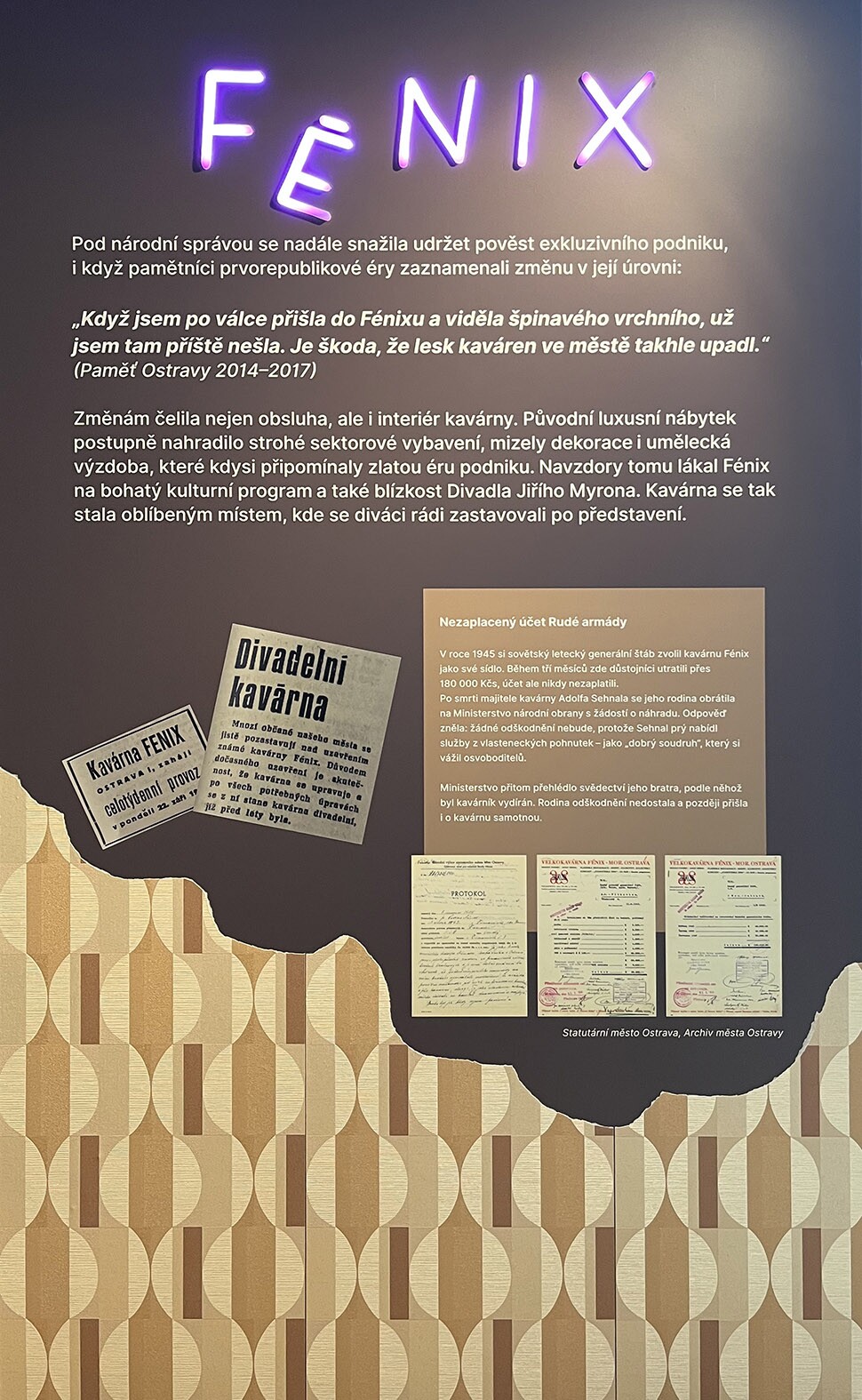
THE FÉNIX CAFÉ
Even under state ownership, the Fénix café tried to maintain its reputation for luxury and exclusivity, though guests who remembered the pre-war years noticed a decline in standards: “When I walked into the Fénix after the war and saw that the manager was dirty, I didn’t return there again. It’s a shame that the glamour of the city’s cafés declined like that.” (Memory of Ostrava 2014–2017)
It was not only the staff that changed, but also the café’s interior. The original luxurious fittings were gradually replaced by austere utilitarian furniture, and the décor and artwork recalling the café’s golden age were also removed.
Despite this, the Fénix attracted visitors with its rich cultural offerings and its proximity to the Jiří Myron Theatre; it became a popular place for audiences to enjoy a drink after a performance.
“You’re a good comrade and a patriot”
The Red Army’s unpaid bill
In 1945, after the Red Army’s liberation of Ostrava, the General Staff of the Soviet Air Force chose the Fénix café as its local headquarters. During their three months there, officers spent over 180 000 crowns, but they never paid the bill.
After the death of the café’s owner Adolf Sehnal, his family contacted the Czechoslovak Ministry of National Defence and requested compensation for the unpaid bill. The answer was that there would be no compensation, because (the Ministry claimed) Sehnal had offered the café’s services out of patriotic motives, having been “a good comrade” who was grateful to the liberators.
However, the Ministry overlooked the testimony given by Sehnal’s brother, who claimed that the café-owner had been a victim of extortion. The family received no compensation, and later the café was confiscated from them.
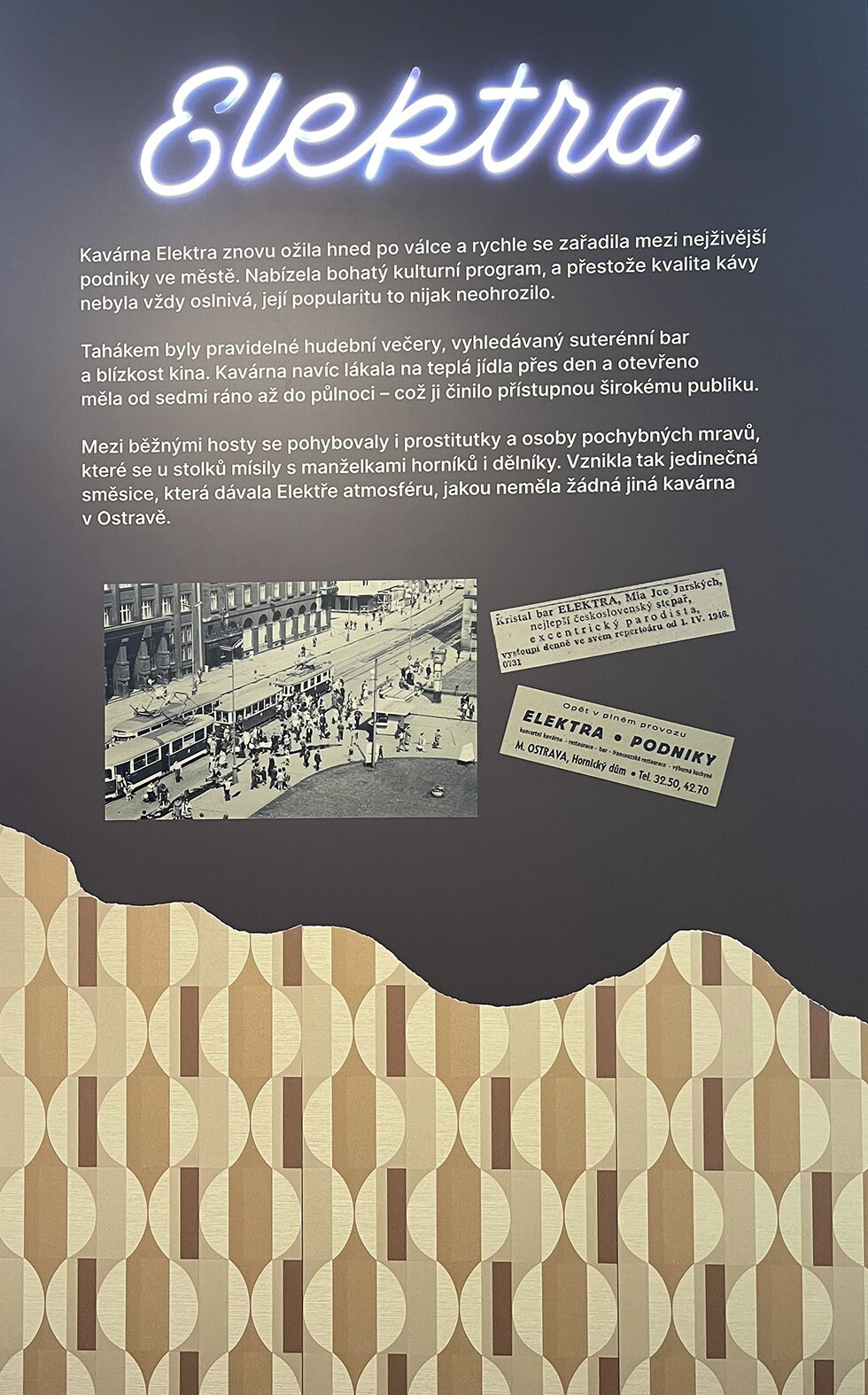
THE ELEKTRA CAFÉ
The fortunes of the Elektra café revived immediately after the war, and it quickly became one of Ostrava’s liveliest establishments. It offered a rich cultural programme, and although the quality of the coffee was not always brilliant, the café nevertheless remained popular.
The regular music nights, the popular basement bar and the café’s proximity to a cinema all attracted visitors. The Elektra also served hot meals during the day, and it was open from 7 a.m. to midnight, so it catered for a wide range of clients.
Among the regulars were prostitutes and people of dubious morals, mingling at the tables with labourers and miners’ wives. This created a unique mix that gave the Elektra an atmosphere unlike anywhere else in Ostrava.
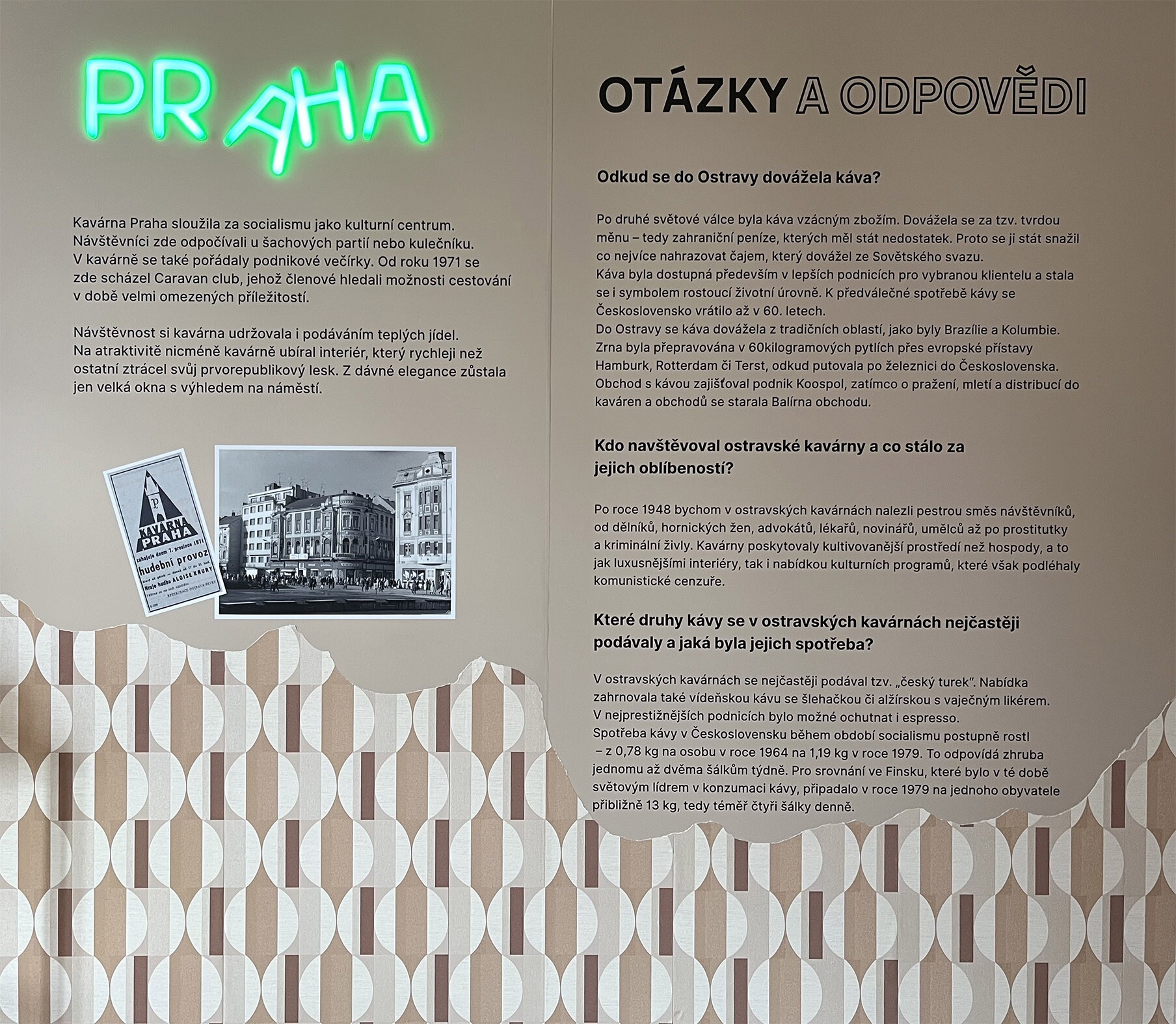
THE PRAHA CAFÉ
During the communist era, the Praha café served as a hub of Ostrava’s cultural life. Guests enjoyed playing chess or billiards, and the café was also used for corporate functions. In 1971 it became the venue for meetings of the Caravan Club, whose members sought out travelling opportunities at a time when travel was heavily restricted.
The café also attracted guests by serving hot meals.
However, the interior of the Praha café was less attractive, as it lost its original inter-war glamour more quickly than Ostrava’s other former grand cafés. The only surviving remnants of the Praha’s former elegance were the large windows facing onto the square.
QUESTIONS AND ANSWERS
Where was coffee imported from?
After the Second World War, coffee was a rare commodity in Czechoslovakia. It was imported for hard currency – in other words foreign currency, which the state lacked. The authorities therefore tried to replace coffee with tea, which was imported from the Soviet Union. Coffee was available in more upmarket establishments catering for a selected clientele, and it became a symbol of rising living standards. It was not until the 1960s that Czechoslovakia returned to its pre-war level of coffee consumption.
Coffee was imported from traditional producers such as Brazil and Colombia. Coffee beans were shipped in 60-kilogram sacks to the European ports of Hamburg, Rotterdam or Trieste, from where the coffee was transported to Czechoslovakia by train. The Czechoslovak coffee bean market was controlled by the state-owned company Koospol, while another state-owned company (Balírny obchodu, meaning “Trade Packing Plants”) handled the processes of roasting, grinding and distributing coffee to cafés and shops.
Who frequented Ostrava’s cafés, and what were the main reasons for their popularity?
After the communists seized power in 1948, Ostrava’s cafés catered for a diverse mix of guests – from manual labourers to miners’ wives, lawyers, doctors, journalists and artists, as well as prostitutes and criminal elements. Cafés offered a more cultivated environment than pubs, with more luxurious interiors and a range of cultural offerings – though these were subject to censorship by the communist authorities.
What types of coffee were most often served in Ostrava’s cafés, and how much did people drink?
The most commonly served type of coffee in Ostrava’s cafés was Czech-style “Turkish” coffee, though cafés also served Viennese coffee (with whipped cream) or Algerian coffee (with eggnog). The most upmarket cafés also served espresso.
Coffee consumption in Czechoslovakia gradually increased during the communist era, from 0.78 kg per person in 1964 to 1.19 kg in 1979 – which is between one and two cups per week. For comparison, in 1979 the country with the highest per capita coffee consumption in the world was Finland, where the average person drank around 13 kg of coffee per year (almost four cups per day).
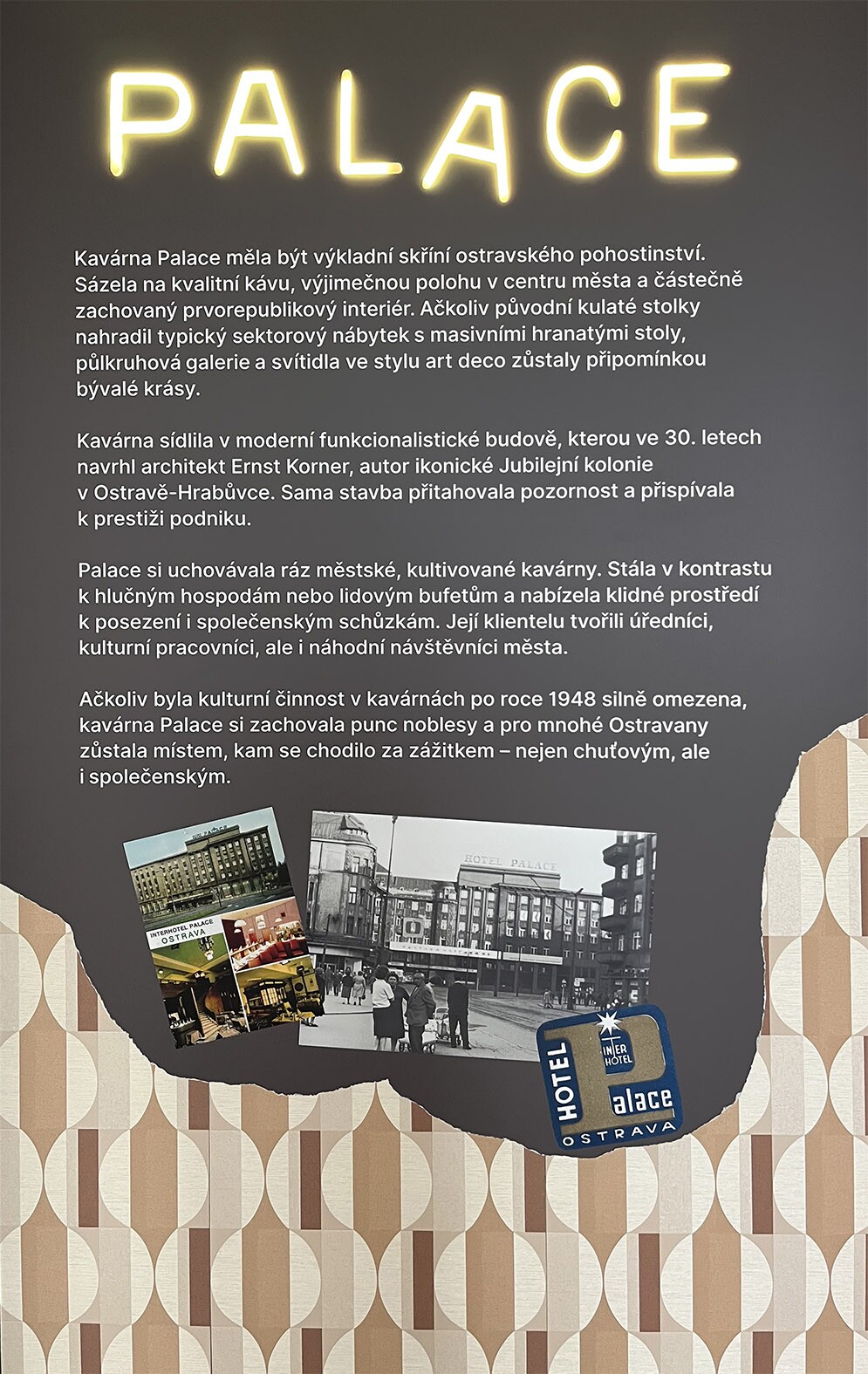
THE PALACE CAFÉ
The Palace café was intended to be a showcase for Ostrava’s hospitality industry, offering high-quality coffee at an exceptional city centre location as well as boasting a partly preserved pre-war interior.
Although the original round tables were replaced by rectangular furniture in a simple utilitarian style, the semicircular gallery and the Art Deco lamps were retained as a reminder of the interior’s former glory.
The café was located in a modern Functionalist building designed in the 1930s by Ernst Korner – who was also the architect of the iconic “Jubilee Colony” (Jubilejní kolonie) housing scheme in Ostrava’s Hrabůvka district. The building itself captured people’s attention and helped boost the café’s prestige.
The Palace café retained its original character as a cultivated and urbane establishment; in contrast with the city’s noisy pubs or basic workers’ canteens, it offered a quiet, refined environment for socializing. The clientele included officials, cultural workers and visitors to the city.
Although cafés’ cultural offerings were severely restricted after communists seized power in 1948, the Palace retained its hallmark of refinement, and for many citizens of Ostrava it was a place to go for a special occasion, offering both a gastronomic and a social experience.
NEXT →
Akce: Otevřít verzi pro tisk