
Ostravské muzeum
https://www.ostrmuz.cz/website/imagemenu/stale-expozice/webpage/webpage%5B9%5D/Mašek's Astronomical Clock
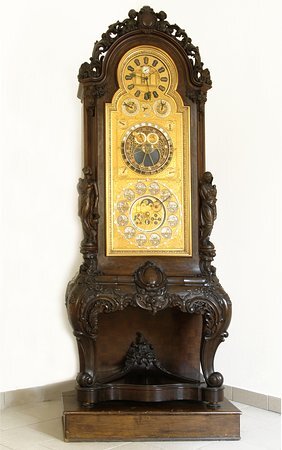
The front of the astronomical clock is gilded and it consists of four parts:
-
In the upper part there is a clock.
-
Under the clock dial there is a calendar, which announces the date along with a day in a month, a week in a year, a number of day in a month and an era.
-
Under the calendar there is an astronomic part. In the middle of this part there is a globe. The axis is determined by 18th meridian and by 50th parallel. It is a place on the earth where Ostrava is situated. So, Ostrava appears as a centre of the globe. On the steady 24 hour dial there is a zodiac, where we can trace in which sigh the Sun and the Moon occur at the moment and we can also follow their illusory location in the cycle. It is also possible to find out lunar and solar phases and the numbers of their cyclamen. Under the globe there is a movable map of the stellar sky. Two disks on the sky show a contingent eclipse of the Sun and the Moon. A light arc on the periphery of the dial presents the length of the day. The dark one presents the length of the night. From their division line we can read the time of the sunrise and the time of the sunset. In the four corners there are little dials setting time in London, Bombay, San Francisco and Tokyo.
-
The fourth part is a planetary one. In the middle of this part there are Sun and eight planets of the solar orbit (Pluto is missing) circulating around it. Our Earth is pictured as a little golden globe around which the Moon circulates. A special ringlet, which follows the course of the Moon, keeps a record of the Moon´s eclipse. On the periphery there are four seasons distinguished by the colours: green = spring, yellow = summer, red = autumn, blue = winter. By means of 12 medallions with their zodiacal signs we´ll find out in which signs individual planets are at the moment. We can follow the phases of the lunar cycle in allegorical performance (such as the smiling golden Moon). On the right of Jan Mašek’s photo you can follow a leap-year – if the arrow is on 4 we are in a leap-year. On the left there is a disk with astronomical indications of the planets, the arrow points at the ruler over the year.
Inside of the astronomical clock there are musical machines. Eight separate opera melodies are repeated every eight day. The musical machine has its turn once a day. During the music we can follow the transformation of the clock dial: The dial on the seconds is hidden and instead of it, the tree of life appears. Eve steps out of the left door and extends the forbidden apple to Adam who appears from the right hand door. Then the tree of life disappears and in its place a little golden cradle appears as a sign of birth. Than the figures are hidden and another part of the transformation is seen. The big clock dial is divided into halves. These halves are hidden afterwards of human life from cradle to the grave appear. At the moment the music stops, the pictures disappear and everything is returned to the original state.