
Ostravské muzeum
https://www.ostrmuz.cz/website/imagemenu/stale-expozice/webpage/webpage%5B4%5D/Ancient History of Ostrava
The city Ostrava straddles the banks of the river Ostravice, but has been regarded as two separate entities all the way back to its beginnings. Both cities, Moravian Ostrava and Silesian Ostrava, had gone about their own separate destinies until they were joined together in 1941. During its prehistory an important trading route called the Amber Road, which linked the Baltic and Adriatic Seas, passed through Ostrava (panel 2, pict. 3). The name Ostrava first appears in a deed issued by Pope Gregory IX in 1229. It was then a village that grew into today’s Silesian Ostrava. Moravian Ostrava, the core of our story, became over time the more important commercial, industrial and social centre of the whole region.
MORAVIAN OSTRAVA
Ostrava was first recorded as a property belonging to the bishop of Olomouc, Bruno of Schauenburg (panel 1, pict. 2), in a testament he set forth on November 29, 1267 (panel 1, pict. 1), before leaving on a crusade to East Prussia and Lithuania with the Czech king, Přemysl Otakar II. A few years later, in 1279, Ostrava was specifically mentioned as a city. Some of the oldest layouts of Ostrava can be found in the map of Czech and German territories belonging to Martin Waldseemüller, dating back to 1513, and another belonging to Jan Amos. Komenský in 1680. The oldest preserved illustrative maps of Moravian Ostrava date to 1699 and 1728 and are the works of unknown authors.
For more than 400 years, 1437 to 1848 to be exact, Moravian Ostrava belonged to the Hukvaldy principality. At the beginning of this periods, both the Moravian and Silesian parts of Ostrava were the property of Jan Čapek of Sany, a Hussite marshal, who had a bridge built over the river Ostravice in 1454.
In the second half of the 14th century, Ostrava received the right to organize fairs, which significantly increased the importance of the city and its commerce. These fairs were held on the location of today’s Masaryk square, while the livestock fairs were held nearby on Smetana square.
The oldest preserved record in Ostrava is the charter od privileges for organizing an annual fair lasting sixteen days, granted on May 17, 1362, in nearby Opava, by the emperor and king Charles IV. (panel 2, pict. 1). The charter is kept today in the city archives.
ST. WENCESLAS’ CHURCH
The first written mention of St. Wenceslas’ Church dates back to 1297, making it the oldest landmark in Moravian Ostrava. Its present look is based on the numerous reconstructions it has undergone since the 13th century. Several archaeological digs conducted at St. Wenceslas’ Church in the second half of the 20th century have revealed many interesting historical anecdotes about the city (panel 3, pict. 7, 8).
Among the finds were fresco paintings depicting the view of Silesian castle in Ostrava dating back to 1555 (panel 3, pict. 3). Works of sculpture include the tombstone of Catherine of Boskovice (panel 3, pict. 4), the daughter of the lord of the Hukvaldy principality, from 1550, the tombstone of Bernard Lev (panel 3, pict. 5), an Italian architect and citizen of Ostrava, who among other helped build the tower of the Old Townhall in 1603, and the tombstone of Jan Jeřábek of Mořkov, a local aristocrat (panel 3, pict. 2). Available sources also indicate the church music was performed here (panel 3, pict. 2).
THE TOWN
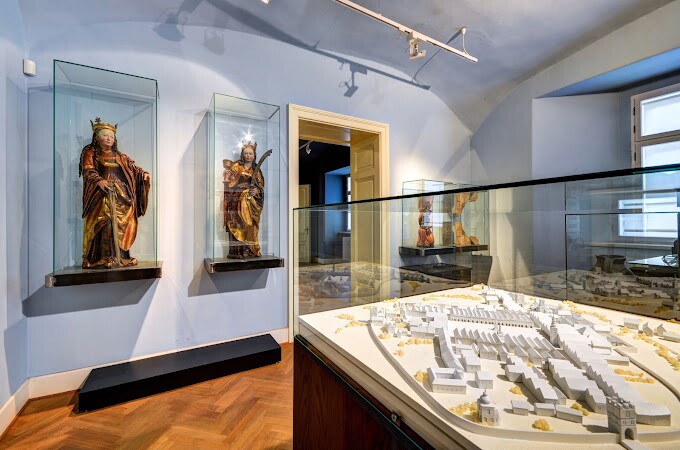
Construction commenced on foundations for the town walls between the years 1371 and 1376, when Bishop Jan Očko of Vlašim owned the principality. The town was surrounded by walls with three gates: Kostelní, Přívozská and Hrabovská. An historic model, called Kolba’s plan, offers a look at Moravian Ostrava in 1750 (panel 4, pict. 1).
Among the sadder events recorded by the town was the fire of 1556, followed by the outbreak of plague in 1625.
The handicrafts industry started to take hold in the 16th century, along with guilds for drapery, weaving, butchers, shoemakers and fishmonging in Moravian Ostrava. By the middle of the 18th century the city was large for its time, with approximately 1,200 residents, all still trying to overcome the lingering effects of the Thirty Years War, as well as several natural disasters and epidemics.
The seat of the city administration was located in the building of the Old Townhall on the Main Square, today’s Masaryk square, in Moravian Ostrava. This oldest standing secular building dates back to 1539. Today the Old Townhall serves as the city museum, providing resident of Ostrava and visitors with information about its social and historical development. Masaryk square with the Old Townhall is depicted in this picture from 1880s (panel 4, pict. 2).
Archaeological objects on display in the exposition come from three areas which significantly contributes to events surrounding Ostrava. The first group consists of findings from Silesian castle, the second from Landek Castle and the third from the city of Moravian Ostrava itself. These objects not only allow us to see what a medieval kitchen and household really looked like but they also draw our attention to certain types of craftwork typical for this region. We can therefore conclude that people like potters, blacksmiths, cabinetmakers and even stove builders were at work in these surroundings. Other interesting archaeological findings include Jan Lucembursky’s Prague groschen, which was discovered during an archaeological dig in the building of the Old Townhall, and a stone cannonball pulled from another archaeological site.
These artistic-historic collections are represented by sculptures and tiles ranking among the oldest objects relevant to our region.