
Ostravské muzeum
https://www.ostrmuz.cz/website/imagemenu/stale-expozice/webpage/webpage%5B12%5D/Ostrava in the Firsthalf of the 20th Century
POLITICAL EVENTS
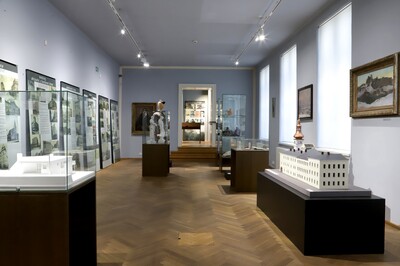
These pictures look back into the history of the city during the last decade of the Austro-Hungarian Empire and the growth of Moravian Ostrava as an industrial city. These views of the Main Square are dated in 1900 and 1908 respectively (panel 1).
The beginnings of the 20th century were marred by the advent of the World War I. and the disintegration of the Austro Hungarian Empire. The declaration of the Republic of Czechoslovakia led to the establishment of the Czech nation in 1918, opening up many new possibilities for development after centuries of foreign rule. The predominance of World War I. in the
history of Central Europe can be seen here in these keepsakes of the Czechoslovakia legionaries.
Jan Prokeš, a social democrat, became the first mayor of Czechoslovakian Moravian Ostrava following the establishment of the century in 1918 (oil on canvas). In his newly installed function as president, Tomáš Garrigue Masaryk visited Ostrava on June 25, 1924 (panel 1, pict. 4, 5, 6). Residents of Ostrava could also catch a glimpse of their future president, Edvard Beneš. This picture shows Beneš with city representatives in front of the New Townhall on August 23, 1937 (panel 1, pict. 8, 9).
Since the old town hall did not provide enough space for the new citywide organization, construction began on New Townhall using a design by architects František Kolář and Josef Rubý. The New Townhall tower rises 85.6 metres and is the highest such Townhall tower in the Czech Republic. The New Townhall was opened in 1930 (panel 1, pict. 7).
In 1923 an exhibition on industry and trade was held between June 16 and July 7 1923 in Moravian Ostrava. It was later prolonged to August 15 due to its enormous success, as evident by the 477,213 visitors who attended it (panel 1, pict. 10–15).
SOCIETY
The city centre continued to expand and overflow into nearby villages, which led to the formation of so-called Greater Moravian Ostrava in 1924. The 1929 zoning plan of the city (panel 2, pict. 1) and nearby surroundings incorporates these villages.
At that time Ostrava was mainly inhabited by workers and miners who arrived from surrounding areas. Industry was flourishing in 1920. People were coming to Ostrava in search of a new and better existence. Communities were newly established to provide accommodation for them. The Salomon community was set up in 1873 directly in the middle of the city centre. The Salomon mine (panel 2, pict. 4a), opened by Salomon von Rothschild in 1844, was also nearly placed in the city centre. Another mine opened in the city was ”Jindřich”, or Henry, established in 1848 by the Austrian state (panel 2, pict. 4b). A new hospital was constructed in a meadow in the area known as Fifejdy. The first buildings were opened up to the public in 1898 (panel 2, pict. 8). The first police station was established in Moravian Ostrava in 1894 (panel 2, pict. 9).
The increasing number of inhabitants strained sanitation and hygienic conditions, leading Moravian Ostrava to move local slaughterhouses to beyond the edge of the city in 1880. The oldest brewery in the city, established in the 18th century, used to be located not far from the area of Černá louka (panel 2, pict. 11). The oldest waterworks was located in Nová Ves and began operation in 1890 (panel 2, pict. 12).
ARCHITECTURE
The growth of the city provides lots of opportunities to architects, known and unknown alike, between the 19th and 20th centuries. Here they could bring their projects to fruition and influence the architectural character of the city. The most outstanding construction in the city centre are depicted in pictures and models. One of the most harmonious projects was based on the idea of linking the main train station to the city centre. This project was carried out under the direction of Camillo Sitte, the court architect in Vienna. The church of the immaculate conception of the Virgin Mary in the Přívoz (panel 3, pict. 1) district forms part of this conception and was finished in 1899. The Townhall in Přívoz was another project of Camillo Sitte and completed in 1897. The building was converted into the Archives of Ostrava in 1960 (panel 3, pict. 2).
Other church buildings include the Basilica of the Saviour in the city centre (panel 3, pict. 5), a project guided by architect Gustav Meretta of Olomouc and finished in 1889, and the Evangelic church of Ostrava (panel 3, pict. 6) designed by architects Karel Troll and Ludwig Faigl and completed in 1907. The Evangelical vicarage was build much earlier than the church itself. The Chapel of St. Luke (panel 3, pict. 7), the second oldest ecclesiastical building in Ostrava, provided spiritual services between 1732 and 1894, when it ceased to exiSt. The bastion in Farska gardens (panel 3, pict. 8) was part of the town walls and located not far from St. Wenceslas’ church. It was demolished in 1930. The first synagogue (panel 2, pict. 9) was located at 6/108 in Zeyerova Street in Moravian Ostrava and was the social and educational centre of the local Jewish community. Constructed in 1879 by Franz G. Böhm, it burned on June 13, 1939. The Jewish cemetery in Moravian Ostrava (panel 3, pict. 10) was established in 1872 as a result of epidemic that swept through the city. The cemetery was closed in 1984 and completely removed four years later. The unique cubist construction of the crematorium (panel 3, pict. 11a/b) was designed by architects Vlastislav Hofman and František Mencl in 1922 and completed three years later. Ostrava lost a major architectural monument when this building was demolished.
CAFETERIAS, COMMERCIAL AND BANKING INSTITUTIONES
Contributing to the atmosphere of the city were many commercial institutions and cafeterias constructed after the establishment of the country. The first cafeterias, a specialized form of three enterprise in Ostrava, were called Austria (panel 4, pict. 2) and Central, later taking the name Astoria.
SOCIAL INSTITUTIONS
Nationalist struggles continued throughout the 19th and 20th centuries in Moravian Ostrava. Having lost their majority, Czech inhabitants felt oppressed with the added insult of losing their culture and participation in the political process. Fearing the comeuppance of the Czechs, the German majority fought to keep the status quo. They were willing to compromise so long as the German character of the city was retained. It was through the construction of colossal buildings that these warring factions manifested their ambitions and hoped to triumph over the other nationalist parties. They can
be seen most clearly in the three ”national” houses and other school buildings. The completion of the Czech national house in 1894 (panel 5, pict. 1a/b) gave the Czech residents a place of their own, where they could carry out most of their cultural and social activities. The German house (Deutsche Haus) was ceremoniously opened that same year, constructed as
a national institution, in the German neorenaissance style by Felix Neumann, on Beneš Square (panel 5, pict. 2a/b).The Czech house in Vítkovice (panel 5, pict. 3a/b) was constructed in 1899 by Bohumil Židlický with the support of growing Czech nationalism in Vítkovice, where the inhabitants were under pressure from local German authorities and management of the Vítkovice iron works to germanise their way of life. Shortly thereafter, in 1900, the Polish minority decided to build their own house, Dom Polski, in Poděbradová Street in Moravian Ostrava (panel 5, pict. 4a/b). The architect was Stanislav
Bandrowski.
CULTURE
Building a theatre made out of stone was an important step in the cultural development of the city. The City Theatre (panel 5, pict. 5), designed by architect Alexander Graf, was opened to great fanfare in 1907 as a vehicle for the German scene. Not until 1919 was the building turned over to Czech artists and recommissioned ad the ”National Moravian-Silesian Theatre”. The House of Arts (Dům umění) in Jurečková Street (panel 5, pict. 7) was built in 1926 under the guidance of architects František Fiala and Vladimír Wallenfels to provide a venue for exhibitions, lectures and concerts. At the time it was the most modern building in the region. The exposition shows the work of artists who lived and worked in our region.
The appearance of several celebrities (panel 6) helped to enrich theatre and concert activities in Moravian Ostrava.
The famous Czech singer Ema Destinnová was a guest artist at the City Theatre in 1923. The renowned pianist and composer Igor Stravinsky gave a performance for the people of Ostrava on January 26, 1933, during his concert tour. The composer and pianist Sergej Prokofjev performed here in 1935. The German violist and composer Paul Hindemith always had a close relationship with Ostrava and performed at the National House in 1931, 1932 and 1936. The famous composer Leoš Janáček was born in nearby Hukvaldy in 1854. His operas were always part of the repertoire and he himself was present at some of the staging. He died after a short illness at the Fifejdy hospital in Ostrava on August 12, 1928.
EDUCATIONAL AND SCHOOL SYSTEM
There was an advanced basic school system in operation before 1900, as well as several city schools and German vocational schools. Among the oldest secondary schools in Moravian Ostrava was the high school and vocational school in Matiční Street (panel 8, pict. 2a/b) established in 1897. Novelist Vojtěch Martínek, whose work looks back at the industrial revolution in Ostrava, taught Czech language and literature here. The German high school in Českobratrská Street (panel 7, pict. 3) was opened in 1896. The Mining school in Moravian Ostrava (panel 7, pict. 5) was the oldest secondary school of this type with Czech as the official language. It was stablished by Mining and Metallurgical industry of the Ostrava-Karviná mining district in 1871. The business academy in Českobratrská Street (panel 7, pict. 6), today part of the building of the Technical University, was established in 1919. The State Technical School in Vítkovice (panel 7, pict. 9) also opened its doors in 1919. Organizing an educational and school system in the region of Ostrava went hand in hand with more and more people moving in form surrounding areas and followed a parallel course with the growing population. A cultural committee for Greater Ostrava (panel 7, pict. 4a) was formed to deal with this expansion in 1921, the purpose of which was to link educational and cultural activities in the region. It offered evening courses and lectures (panel 7, pict. 4b), concerts and exhibitions for everybody in the new Czechoslovak Republic. It also helped found several institutions in Ostrava, like Masaryk National University, the museum of history and industry, and exhibition grounds. The former fire station (panel 7, pict. 11) was built on Smetana Square in 1892 but ceased to exist in 1946. Broadcasting from the offices of Czech Broadcasting in Ostrava was launched here in 1929.
SPORTS AND LEISURE TIME
The Karolin Spa (panel 8, pict. 1) was one of the places where the people of Ostrava could spend their leisure time with sports, entertainment and plain relaxing. The spa was open for nearly one hundred years, between 1850 and 1960, with the central spa (panel 8, pict. 2) welcoming visitors first in 1901. There were all sports of healing baths and swimming pools available. Another swimming pool not far from the pub “U Dubu” in Silesian Ostrava (panel 8, pict. 3) was opened
in 1906, the one in nearby Hulváky in 1929 (panel 8, pict. 11). Hotel Gambrinus (panel 8, pict. 4) was another interesting place, not least because it used to be the place where, starting in October 1896, the first silent film was shot in the Czech lands. Line at the conjunction of the rivers Odra and Ostravice gave the people of Ostrava lots of opportunities for water sports. The Perun rowing club (panel 8, pict. 5a/b) was first Czech sports club in Přívoz, established in 1893. The members of the Sokol Moravian Ostrava guild constructed their own building for their activities in 1932. The building took its name from Jan Čapek (panel 8, pict. 8), founder of the Czechoslovakian legion in Italy and a long-time leader of the Sokol group in the Moravian-Silesian district. Their gatherings at times could boast more than 5,000 participants. This picture captures their typical activities at the third annual Sokol meeting in Moravian Ostrava in 1922 (panel 8, pict. 7a/b). The most famous local sport club is Baník Ostrava, founded on September 8, 1922, at the restaurant “U Dubu” by twenty poor inhabitants of the mining community in Kamenec. The name of the club at that time was SK Silesian Ostrava. This picture shows the first team of SK Silesian in the spring of 1923 (panel 8, pict. 9). An ice rink (panel 8, pict. 12) was ceremoniously opened in 1947 on the location where an older rink and tennis courts stood. It became an indoor stadium with a unique cast iron construction, the first of its kind in postwar Czechoslovakia, in 1951. The stadium was demolished in 2003 as part of the city’s urban renewal program.